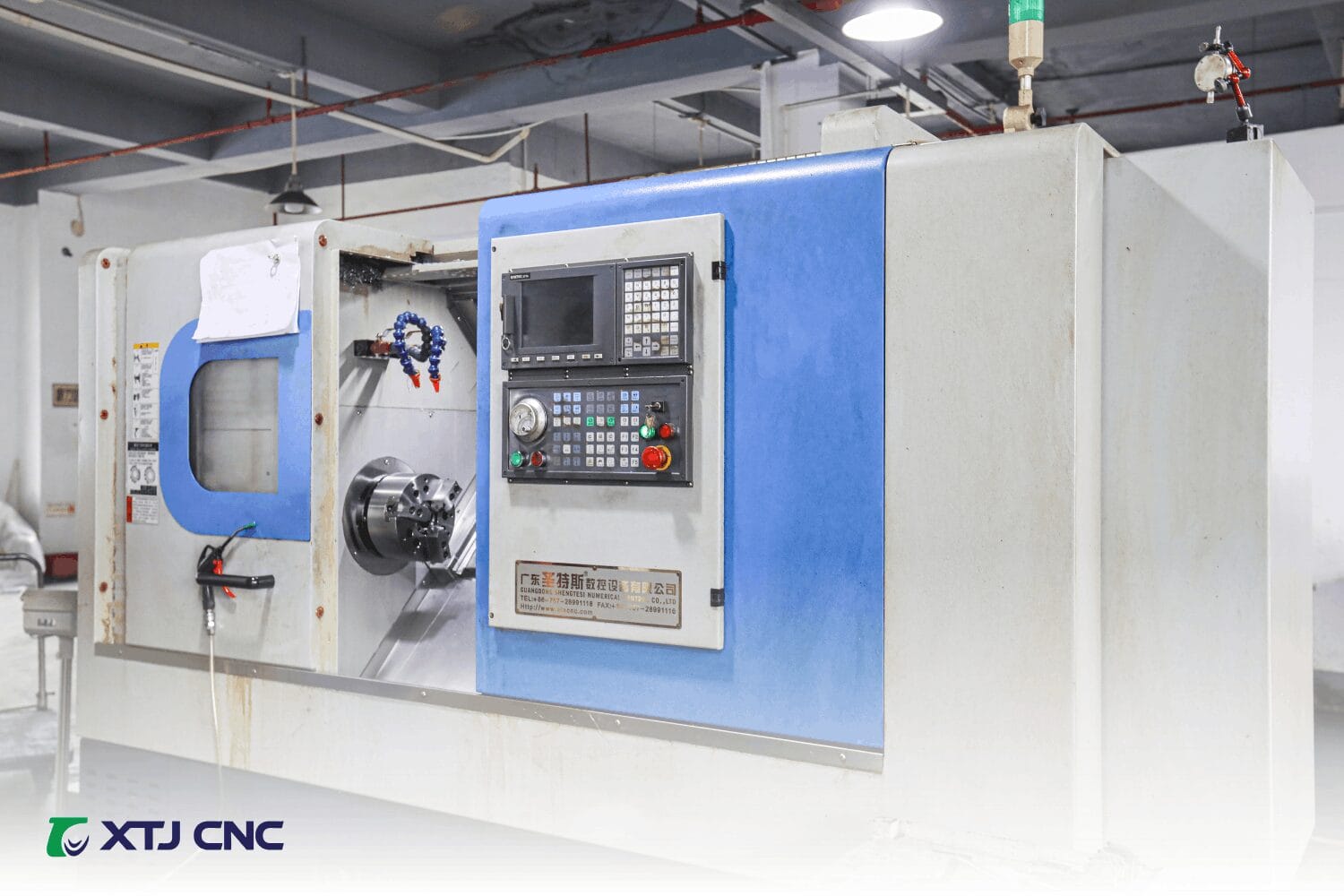
Swiss-type turning exists because some parts cannot be made any other way. If you are machining slender shafts, small-diameter pins, or connector components with length-to-diameter ratios above 3:1, a conventional CNC lathe will not deliver the precision you need. The workpiece deflects, tolerances drift, and your scrap rate climbs.
Swiss-type lathes solve this with a sliding headstock and guide bushing that supports the bar stock right at the cutting zone, keeping deflection under control even on parts as small as 0.5 mm in diameter. Industries including medical devices, electronics, and precision instrumentation rely on this process for components where ±0.005 mm is not a suggestion—it is a baseline requirement.
China has become one of the most competitive regions for precision Swiss turning. Lower operating costs, heavy investment in CNC Swiss lathes from Citizen and Star Micronics, and a growing base of ISO-certified turning specialists mean buyers can source high-tolerance turned parts at 30 to 50% less than equivalent Western shops. The distinction that matters is knowing which suppliers actually run Swiss-type equipment—and which are quoting on standard gang-tool lathes and presenting it as equivalent.
This guide profiles 10 China-based Swiss turning specialists, covers what to evaluate before sending an RFQ, and explains the CNC vs. cam-driven distinction that most sourcing guides skip entirely.
What is Swiss-type turning and When Should You Use it?
Swiss-type turning (also called Swiss screw machining) uses a sliding headstock to feed bar stock through a guide bushing while cutting tools remain stationary or move along fixed axes. The guide bushing grips the material within millimeters of the cut, dramatically reducing vibration and deflection—the two factors that destroy accuracy on slender parts.
On a standard CNC lathe, the workpiece extends from the chuck unsupported. The longer the part relative to its diameter, the more it flexes under cutting forces. Once you exceed a length-to-diameter (L/D) ratio of about 3:1, you’re working against physics. Swiss-type lathes bypass this limit because the bar stock is always supported near the tool contact point, regardless of part length.
Swiss turning makes sense when your part meets one or more of these conditions:
- Diameter range: Typically 0.5 mm to 32 mm, though most Swiss machines run most efficiently in the 1 to 20 mm range.
- L/D ratio above 3:1: Any part where the length exceeds three times the diameter benefits from guide bushing support.
- Tight tolerances: Swiss lathes routinely hold ±0.005 mm on diameter and ±0.01 mm on length. Precision shops reach ±0.002 mm on critical features.
- High-volume runs: Automatic bar feeders enable lights-out production, making Swiss turning cost-effective for batches above 500 pieces.
- Complex features in one setup: Modern CNC Swiss lathes with live tooling can mill flats, cross-drill holes, and cut threads without removing the part from the machine.
Typical components include medical bone screws, dental implant abutments, connector pins, precision instrument shafts, valve stems, sensor housings, and small automotive shafts.
How to Evaluate a Swiss Turning Supplier in China
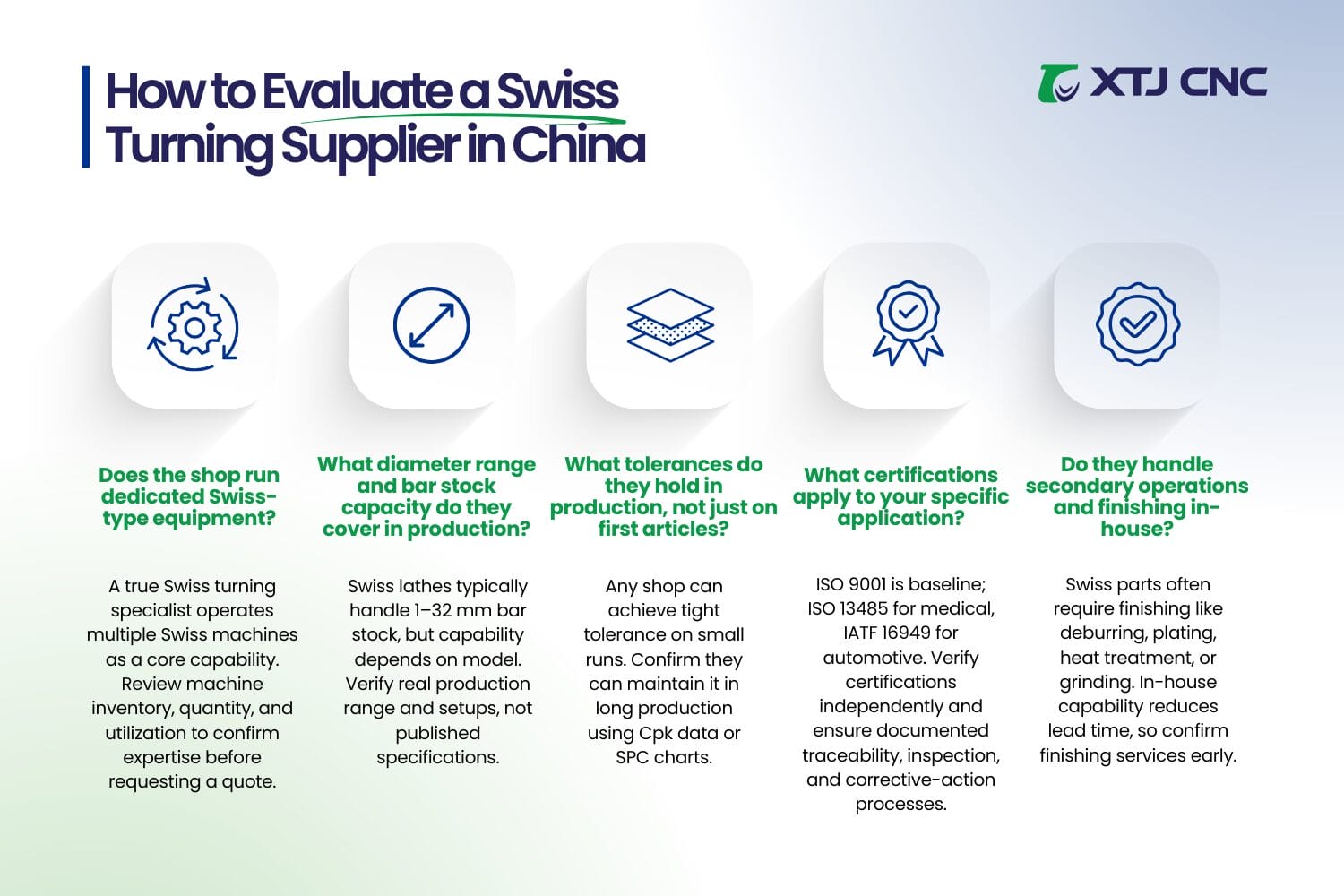
Swiss turning is a specialist process. Five questions separate a genuine specialist from a general CNC shop that owns one Swiss lathe.
Does the shop run dedicated Swiss-type equipment?
A supplier with five Citizen L20 machines and a Star SR-20J on the floor is a Swiss turning shop. A supplier with 50 three-axis mills and one Swiss-type lathe in the corner is a general CNC shop that owns one. Machine count, volume, and utilization tell you whether Swiss turning is their core competency or an afterthought. Ask for their machine inventory list – brand, model, and quantity – before you send an RFQ.
What diameter range and bar stock capacity do they cover in production?
Most CNC Swiss lathes handle bar stock from 1 mm to 32 mm, but the sweet spot varies by machine model. If your part is 0.8 mm in diameter, you need a shop with micro-machining Swiss capability—specialized guide bushings and collets designed for sub-millimeter stock. If it’s 25 mm, you need the right collet and guide bushing setup for that diameter. Ask what they run in regular production, not what the machine’s published specification says.
What tolerances do they hold in production, not just on first articles?
Any shop can hit ±0.005 mm on five parts during a first-article run. The question is whether they hold it across 5,000 parts at 2:00 a.m. when the machine has been running for 14 hours. Ask for process capability index (Cpk) data or statistical process control (SPC) charts from a comparable past job. Suppliers who track process capability are the ones you want for production runs.
What certifications apply to your specific application?
ISO 9001 is the baseline. Medical components require ISO 13485. Automotive buyers need IATF 16949. These certifications don’t guarantee quality on their own, but they indicate documented processes for traceability, inspection, and corrective action—things that matter when you’re running tight-tolerance parts at volume. Verify certification numbers independently; don’t rely on a PDF from the supplier.
Do they handle secondary operations and finishing in-house?
Swiss-turned parts frequently need deburring, passivation, plating, heat treatment, or centerless grinding for critical outside diameter (OD) tolerances. A shop that handles these in-house saves coordination time and compresses lead time. Ask about finishing capabilities before committing – not after the first order comes back needing additional processing.
Comparison Table: Top Swiss-Type Turning Manufacturers in China
All manufacturers listed below are service providers. Lead times are based on publicly stated capabilities—contact each supplier directly for project-specific timelines.
| Company | Location | Diameter Range | Tolerance | Lead Time | Key Certifications |
|---|---|---|---|---|---|
| XTJ CNC | Dongguan | 1–32 mm | ±0.003 mm | Prototype from 5 days | ISO 9001, IATF 16949 |
| AT-Machining | Shenzhen | 0.5–25 mm | ±0.005 mm | Prototype from 3 days | ISO 9001, ISO 13485 |
| PTJ Hardware | Dongguan | 1–26 mm | ±0.005 mm | 3-shift production | ISO 9001 |
| NAITE Tech | Changzhou | 2–32 mm | ±0.005 mm | Per quote | ISO 9001 |
| Runsom Precision | Zhongshan | 1–25 mm | ±0.005 mm | Per quote | ISO 9001, ISO 14001 |
| Yijin Solution | Shenzhen | 1–20 mm | ±0.005 mm | Prototype to production | ISO 9001 |
| AP MFG | Shenzhen | 0.5–20 mm | ±0.005 mm | Per quote | ISO 9001 |
| Lemo Machining | Shenzhen | 1.6–25 mm | ±0.005 mm | Volume-optimised | ISO 9001 |
| Worthy Hardware | Dongguan | 2–25 mm | ±0.005 mm | Per quote | ISO 9001 |
| Allied Technologies | Multi-site (CN) | 1–32 mm | ±0.005 mm | Multi-site capacity | ISO 9001, IATF 16949 |
Top Swiss-Type Turning Manufacturers in China
1. XTJ CNC
Location: Dongguan, Guangdong
XTJ CNC operates a 12,000 m² facility in Dongguan with 120+ CNC machines spanning 3-axis to 5-axis milling, standard CNC turning, and Swiss-type turning. Swiss turning capability covers bar stock from 1 to 32 mm with tolerances down to ±0.003 mm – the tightest figure on this list – verified through CMM inspection with full material traceability.
IATF 16949 certification applies automotive-grade process discipline across every order, including Swiss-turned components. There’s no MOQ: 10 prototypes and 5,000 production parts go through the same engineering and inspection workflow. Every new part receives a free DFM review before production begins, with feedback delivered alongside the quote. Prototype lead times run as few as five days; standard production orders typically ship within 10 to 15 days.
For projects that combine Swiss-turned parts with milled housings, sheet metal brackets, or surface finishing, XTJ CNC handles all of it under one roof. See the full capability overview on the XTJ CNCmachining page.
Suited to: Prototype-to-production Swiss turning across multiple materials, automotive-grade quality systems, buyers who need ±0.003 mm precision with no MOQ restrictions.
2. AT-Machining
Location: Shenzhen, Guangdong
AT-Machining is a Shenzhen-based precision machining provider with dedicated Swiss CNC machining alongside milling, turning, and wire EDM. Multi-axis Swiss lathes handle components as small as 0.5 mm in diameter, which positions them well for medical device and microelectronics applications where sub-millimeter precision is a production requirement.
Finishing options include passivation, anodizing, nickel and gold plating, and centerless grinding—all relevant for the medical and connector applications their Swiss capability targets. ISO 9001 certified with ISO 13485-compliant processes for medical component sourcing.
Suited to: Sub-millimeter Swiss-turned parts for medical devices and microelectronics, buyers who need integrated finishing, including centerless grinding and precious metal plating.
3. PTJ Hardware
Location: Dongguan, Guangdong
PTJ Hardware positions itself as a Swiss machining specialist, operating 50+ Swiss-type CNC lathes and 40 longitudinal lathes across three production shifts daily. That machine count is significant for a focused turning operation and signals that Swiss turning is the primary business, not an add-on to a broader CNC service.
Capabilities span both CNC Swiss turning and cam-driven automatic lathe work, covering prototype through high-volume production for medical, electronics, and industrial markets. For buyers whose volumes justify cam-driven production (100,000+ simple parts), PTJ is one of the few shops on this list with genuine cam-automatic capacity alongside CNC Swiss.
Suited to: High-volume Swiss turning, buyers who need cam-driven production alongside CNC Swiss, and operations requiring three-shift continuous output.
4. NAITE Tech
Location: Changzhou, Jiangsu
NAITE Tech is a precision CNC turning manufacturer specializing in complex turned and turn-mill components. Live tooling systems and Swiss-type machining capability cover components requiring tight tolerances and fine surface finishes. Based in Changzhou rather than the Guangdong manufacturing cluster, they offer a geographic alternative for buyers who want to diversify their supply chain within China.
NAITE supports both low-to-medium volumes and scalable production, focusing on dimensional repeatability. For buyers who’ve experienced single-region supply chain exposure and want a Jiangsu-based alternative without compromising precision, NAITE is worth including in your RFQ process.
Suited to: Complex turn-mill components with live tooling requirements, buyers seeking a Swiss turning supplier outside Guangdong Province for supply chain diversification.
5. Runsom Precision
Location: Zhongshan, Guangdong
Runsom Precision provides Swiss CNC machining as part of a broader precision manufacturing portfolio covering 3-axis to 5-axis milling, turning, and 3D printing. ISO 9001 and ISO 14001 certified, serving automotive, electronics, and medical industries. Their Swiss machining content demonstrates solid technical understanding of the guide bushing principle and the sliding headstock mechanism – a reasonable signal that they run genuine Swiss-type equipment rather than standard gang-tool lathes.
For buyers who need Swiss turning as one process within a multi-operation project, Runsom’s integrated capability reduces vendor count without requiring a premium specialist shop for the turning step alone.
Suited to: Multi-process projects combining Swiss turning with milling or finishing, buyers with ISO 14001 supply chain requirements.
6. Yijin Solution
Location: Shenzhen, Guangdong
Yijin Solution has been providing custom manufacturing from Shenzhen since 2003. Processes include CNC precision machining with multi-axis centers and Swiss-type lathes, alongside sheet metal fabrication, 3D printing, injection molding, and die casting. Annual output reaches 500,000+ precision parts. Swiss-type lathe capability handles long, slender shafts and precision-turned components within a broader manufacturing ecosystem.
The scale and process breadth make Yijin Solution practical for product development programs that start with Swiss-turned prototypes and expand into multi-process production across different component types.
Suited to: Multi-process projects where Swiss-turned parts are one component in a larger assembly requiring milling, molding, or sheet metal fabrication.
7. AP MFG
Location: Shenzhen, Guangdong
AP MFG markets itself specifically as a Swiss-type machining company, with a narrower service focus than most competitors on this list. Stated capability covers diameters as small as 0.5 mm for electronic connectors, medical pins, and precision instrument components. The dedicated Swiss-type positioning suggests this is a core competency rather than a bolt-on offering.
As with any specialist supplier, verify machine inventory and request sample inspection reports during the quoting stage before committing. A focused service model is an advantage when the core process is genuinely strong; confirm that before placing production volumes.
Suited to: Small-diameter precision parts for electronics and instrumentation, buyers who want a Swiss-type specialist rather than a generalist CNC shop.
8. Lemo Machining
Location: Shenzhen, Guangdong
Lemo Machining offers CNC Swiss lathe services within a broader precision machining portfolio. Production covers handles, knobs, valve components, nozzle pins, and electronic hardware. The working diameter range starts at approximately 1.6 mm. Both Swiss-turned and conventionally turned components are available, giving buyers flexibility in process selection based on part geometry.
Lemo positions competitively on pricing for mid-to-high-volume orders. For buyers where cost per part is the primary driver and tolerances sit at the standard production tier (±0.01 mm or wider), they offer a practical, cost-efficient route to getting Swiss-turned parts made at volume.
Suited to: Cost-sensitive mid-to-high-volume Swiss turning, valve components, hardware, and electronic parts at standard precision levels.
9. Worthy Hardware
Location: Dongguan, Guangdong
Worthy Hardware specializes in Swiss turning and precision multi-operation machining for small mechanical parts. Tolerances reach ±0.005 mm on shafts and miniature components. Founded in 2008, ISO 9001 certified. Their workflow supports multi-operation machining in a single setup, eliminating the cumulative positioning errors that come from moving parts between multiple fixtures.
Specialization in fasteners alongside Swiss-turned components signals strong fixturing and workholding knowledge—relevant for any shop producing high-precision small parts at volume. Single-setup accuracy is the differentiator here; if your part has multiple precision features that need to hold position relative to each other, that matters.
Suited to: High-precision shafts, pins, and miniature mechanical components where single-setup accuracy eliminates cumulative positioning error.
10. Allied Technologies International
Location: Multiple sites (China and India)
Allied Technologies operates Swiss-type turning and cold-forming facilities in both China and India. The China facility handles Swiss-turn parts, cold forming, and multi-axis precision milling. ISO 9001 and IATF 16949 certified, with an automotive industry focus. The dual-region model is relevant for buyers who want to split sourcing between China and India for risk diversification or landed-cost optimization.
Production Part Approval Process (PPAP) documentation and cross-regional sourcing capability are the differentiators here. For automotive supply chain buyers whose customers require multi-site IATF-certified sourcing, Allied Technologies is one of the few options on this list that can deliver that structure.
Suited to: Automotive buyers needing IATF 16949-certified Swiss turning, PPAP documentation, and the option to diversify production across China and India.
CNC Swiss vs. Cam-Driven Swiss: What Buyers Need to Know
Not all Swiss-type lathes are CNC-controlled, and this distinction matters more than most buyers realize. Older cam-driven Swiss machines (sometimes called cam automatics) use mechanical cams to control tool movement. They’re reliable for simple, high-volume parts with fixed geometries, but they lack flexibility. Changing a part design means re-cutting physical cams, a process that can take days.
CNC Swiss-type lathes replace those cams with servo-driven axes and computer control. The table below shows what that means in practical terms for your sourcing decision.
| Feature | CNC Swiss | Cam-Driven Swiss |
|---|---|---|
| Geometry flexibility | High – program changes in minutes | Low – cam re-cutting required |
| Tolerance capability | ±0.002 to 0.005 mm typical | ±0.01 to 0.02 mm typical |
| Setup time | 30 to 90 minutes | 4 to 8 hours (cam cutting) |
| Live tooling | Yes – milling, drilling, tapping | Limited or none |
| Best for | Prototypes to mid-volume complex parts | Very high-volume simple parts (100k+) |
| Cost per part at mid-volume | Higher upfront, lower per-part at volume | Lower once cams are cut, inflexible after |
When evaluating a Chinese supplier, ask directly: Are you running CNC Swiss-type lathes or cam automatics? A shop with genuine CNC Swiss capability will name machine brands and models without hesitation—Citizen, Star Micronics, Tsugami, Tornos, or equivalent. Shops that can’t answer that question clearly are telling you something.
How XTJ CNC’s Swiss Turning Capability Fits Your Project
XTJ CNC is not exclusively a Swiss-turning shop—and for most buyers, that’s an advantage. The 12,000 m² facility in Dongguan covers Swiss-type turning within a complete manufacturing ecosystem: 3-axis to 5-axis CNC milling, standard turning, turn-milling, sheet metal fabrication, and surface finishing under one roof. A project that begins as a Swiss-turned shaft can expand to include milled housings, formed brackets, and plated surfaces without adding a single vendor to your list.
What does that mean specifically for Swiss-turning work?
Tolerance capability. ±0.003 mm across milling and turning operations, backed by CMM inspection and traceable material records on every order. For Swiss-turned components in stainless steel, brass, or titanium where dimensional consistency across a production run matters as much as the first-article result, that inspection infrastructure is what the tolerance figure actually rests on.
No MOQ, same process discipline. 10 prototypes and 5,000 production parts go through identical engineering review, inspection, and documentation. The DFM review on a 10-piece prototype is the same review that catches the feature driving 30% of your per-part cost before you’ve committed to a full run.
Certifications that follow the part. ISO 9001 and IATF 16949 apply to every Swiss-turned component that leaves the facility. For automotive customers whose Tier 1 suppliers require certified documentation at every supply chain level, that’s not a premium tier—it’s a baseline requirement XTJ CNC meets as standard.
If you’re sourcing precision Swiss-turned parts from China, upload your drawings or send your RFQ to XTJ CNC. Pricing and DFM feedback come back within 24 hours.
FAQs on Swiss-Type Turning Manufacturers
What diameter range is best suited for Swiss-type turning?
The most efficient operating window for Swiss-type lathes is 1 to 20 mm in diameter, though machines handle 0.5 mm to 32 mm depending on the model. The edge cases are where supplier selection becomes critical. Parts below 1 mm require a shop with dedicated micro-machining Swiss capability – specialized guide bushings and collets designed for sub-millimeter stock. Above 32 mm, conventional CNC turning with a steady rest or tailstock support is almost always more practical and cost-effective. Confirm diameter capability in production, not just on the machine’s specification sheet.
Is Swiss turning cost-effective for short runs?
It depends on the part. CNC Swiss lathes have relatively fast setup times (30 to 90 minutes) compared to cam-driven alternatives, so short runs of 50 to 200 pieces are viable for prototyping or bridge production. The economics improve significantly at 500+ units as setup and programming costs amortize across more parts. For single-piece prototypes, conventional CNC turning may be cheaper unless the part’s L/D ratio or feature complexity specifically requires guide bushing support.
What documentation should I request with a Swiss turning quotation from China?
At minimum: a machine inventory list (brand, model, and count of Swiss-type lathes), a first-article inspection report from a comparable past job, and material certifications for the alloys you need. For production runs, request Cpk values and SPC charts demonstrating tolerance consistency over extended runs. If your application requires traceability, confirm the supplier can provide lot-level documentation and certificates of conformance. Suppliers who proactively offer this information without being asked are the more reliable ones.
Can Swiss-type turning handle engineering plastics and exotic alloys?
Yes, though material selection affects both supplier choice and cost. Most China-based Swiss turning shops handle brass, stainless steel, aluminum, and carbon steel as standard. Engineering plastics like PEEK, Delrin (POM), and PTFE are also machinable on Swiss lathes but require shops with experience managing chip control and thermal sensitivity specific to polymers. Exotic alloys such as titanium and Inconel are technically feasible but demand carbide or coated tooling and slower feed rates, which increases cost per part. When sourcing these materials, ask whether the shop has run production jobs in the same alloy—not just test cuts. IQS Directory’s Swiss machining guide provides a useful technical overview of materials and process considerations.
Back to Top: Top Swiss-Type Turning Manufacturers in China (2026)