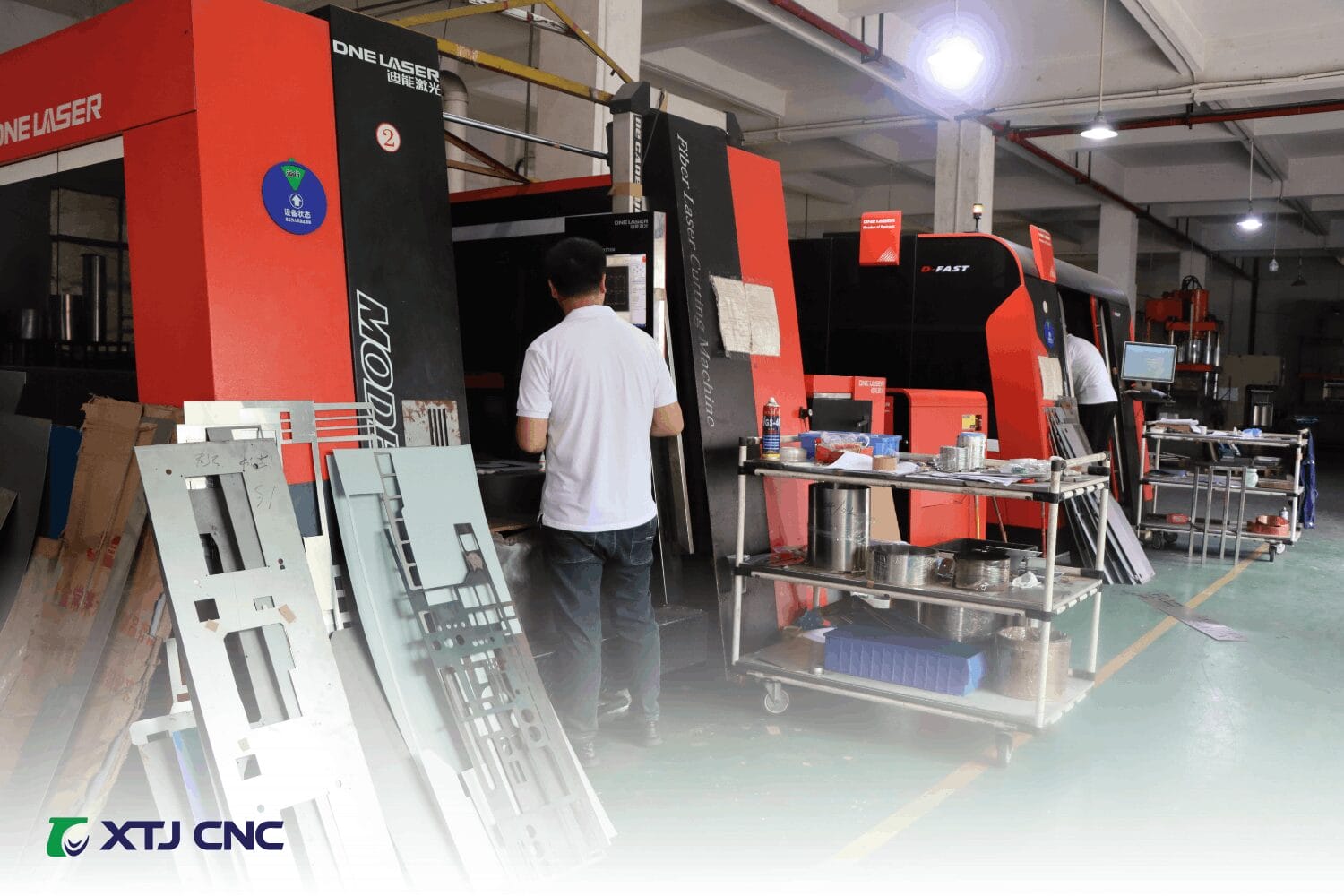
Every consumer electronics product depends on its enclosure. The housing must dissipate heat, block electromagnetic interference (EMI), meet IP-rated dust and water resistance specifications, and deliver the cosmetic quality that retail consumers expect. Get any of those requirements wrong, and the product fails before the first customer review goes live.
China dominates the supply side of this problem. The cluster of aluminum extrusion plants, CNC machining shops, die-casting foundries, and sheet metal fabrication houses concentrated in Guangdong Province produces enclosures for OEMs across four continents. Raw material suppliers, anodizing and powder coating lines, tooling shops, and logistics hubs all sit within the same industrial corridors—a density that compresses lead times and keeps overhead costs competitive in ways that fragmented supply chains elsewhere struggle to match.
This guide covers what consumer electronics enclosures need to deliver, how enclosure type maps to manufacturing process, and 10 China-based suppliers worth putting on your shortlist.
How to Evaluate a China-Based Enclosure Manufacturer: A Supplier Scorecard
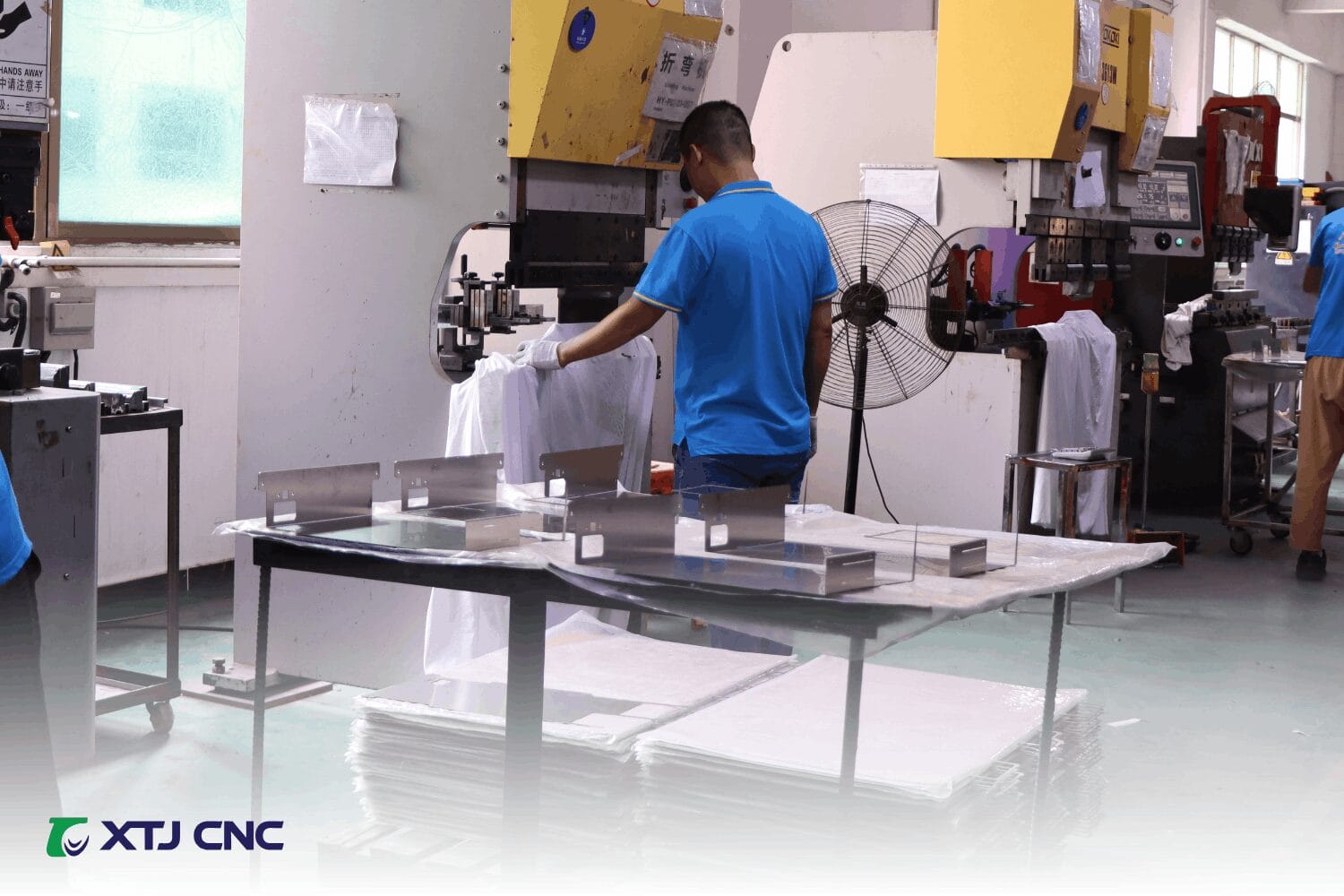
Consumer electronics enclosure sourcing involves more variables than standard machining procurement. The table below gives you a structured evaluation framework—seven criteria, why each matters, and the specific question to ask each supplier before you shortlist.
| Evaluation Criterion | Why It Matters | What to Ask |
|---|---|---|
| Manufacturing method range | CNC, extrusion, die-casting, and sheet metal cover different geometries and volumes. A supplier locked into one method limits your options as the product evolves. | Can you handle CNC machining, extrusion, and sheet metal from the same facility? What are the per-unit cost crossover points between methods? |
| In-house finishing | Outsourced anodizing, powder coating, or silk screening adds lead time and introduces a quality handoff. Cosmetic failures on retail products are expensive. | Is surface finishing done in your facility or subcontracted? Can you show finished sample parts with your standard anodizing? |
| IP rating capability | IP54, IP65, IP67, and IP68 each require different gasket grooves, mating surface tolerances, and cable entry designs. Not all shops understand the machining implications. | Have you produced enclosures to a verified IP rating (not just design intent)? Can you share test reports? |
| Thermal management expertise | A fanless enclosure that overheats is a failed product. Integrated fins, heat pipe channels, and thermal interface pad recesses need to be designed and machined correctly. | Have you produced enclosures with integrated thermal management features? Can you share thermal simulation or test data? |
| DFM support and prototype speed | Consumer product cycles are short. Catching a design problem before tooling commitment saves weeks and thousands in rework. | Do you provide a free DFM review before quoting? What is your CNC prototype lead time for a new enclosure design? |
| MOQ flexibility | Hardware teams iterating on design need low-volume runs without punitive pricing. A supplier requiring 500-unit minimums is not a development partner. | What is your minimum order quantity for CNC-machined enclosures? Does the same pricing tier apply to 20 units as to 200? |
| Certifications | ISO 9001 is the baseline. RoHS compliance is mandatory for EU-bound products. IATF 16949 matters for automotive electronics. IEC 62368-1 familiarity signals a supplier who understands the full compliance chain. | Which certifications do you currently hold? Are you RoHS compliant, and can you provide documentation? |
*Run this scorecard against every supplier you’re considering. The answers reveal more about genuine capability than any website or capability brochure.*
Comparison Table: Top 10 Consumer Electronics Enclosure Manufacturers in China
Lead times reflect typical custom orders of 100 to 500 units and vary by geometry, finish, and volume. “Project-specific” under IP Rating indicates the supplier builds to your specification rather than offering a fixed catalogue rating.
| Manufacturer | Location | Enclosure Types | Key Materials | IP Rating | MOQ | Lead Time | Certifications |
|---|---|---|---|---|---|---|---|
| XTJ CNC | Dongguan | CNC machined, sheet metal, rackmount | Al 6061/6063, steel, plastics | Project-specific | No MOQ | 5 to 15 days | ISO 9001, IATF 16949 |
| Davantech | Dongguan | CNC, extruded, die-cast, forged | Aluminum alloys | Project-specific | No MOQ (CNC) | 10 to 20 days | ISO 9001 |
| CHANGHE | Zhejiang | Extruded, waterproof, DIN-rail, console | Aluminum, plastics | IP65, IP67 | Volume-friendly | 15 to 25 days | ISO 9001:2015 |
| YaJi Aluminum | Foshan | Extruded profiles, heat sink housings | Al 6063, 6061 | Project-specific | Varies | 15 to 25 days | ISO 9001 |
| Yonggu | Foshan | Rackmount, IP68, instrument chassis | Aluminum alloys | Up to IP68 | Low-volume available | 15 to 20 days | ISO 9001 |
| OMK Electronics | Shenzhen | Plastic IP67, metal, IoT, LoRaWAN | Aluminum, ABS, PC | IP67 | Flexible | 10 to 20 days | ISO 9001, RoHS |
| Hokare | Guangdong | CNC machined aluminum | Aluminum alloys | Project-specific | Medium volume | 10 to 20 days | ISO 9001 |
| Peak Fasten Tech | Guangdong | Handheld, die-cast, rackmount, IP67 | Al, stainless, plastics | IP67 | 1 unit | 7 to 15 days | ISO 9001 |
| Xingyong | Guangdong | Extrusion, heat sink, IP65+ | Al 6xxx series | IP65+ | Bulk orders | 15 to 25 days | ISO 9001, IATF 16949 |
| MaidaTech | Guangdong | CNC, extruded, injection molded | Aluminum, plastics | Project-specific | Low-volume available | 15 to 25 days | ISO 9001 |
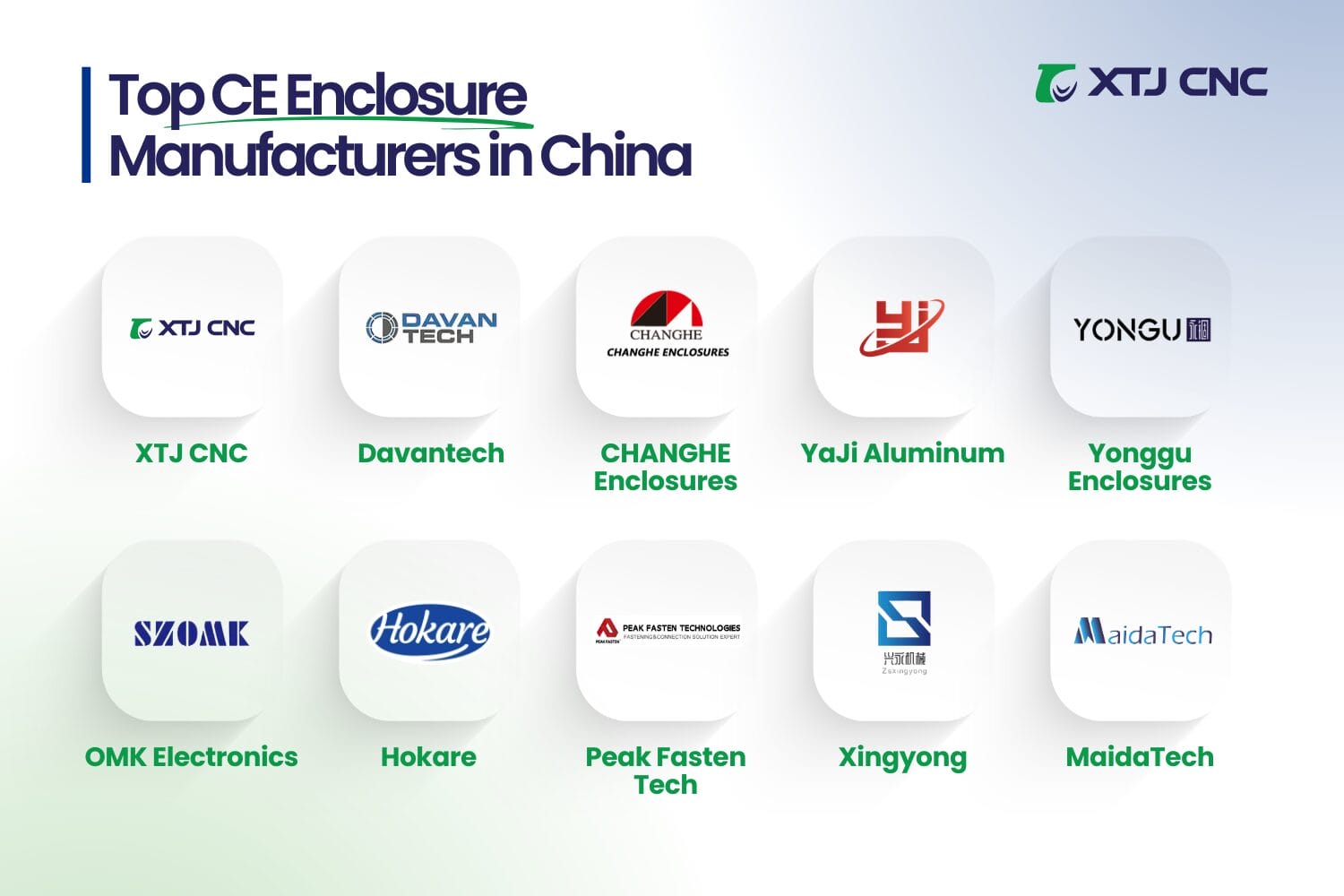
Top 10 Consumer Electronics Enclosure Manufacturers in China
1. XTJ CNC
XTJ CNC operates a 12,000 m² facility with 120+ CNC machines spanning 3-axis through 5-axis milling, turning, and turn-milling centers. Custom enclosures for consumer electronics, medical devices, and industrial equipment are built through CNC machining and sheet metal fabrication within the same facility. Tolerances reach ±0.003 mm on critical features.
For consumer electronics specifically, XTJ CNC handles CNC-machined aluminum housings, sheet metal rackmount chassis, and complex enclosure geometries with in-house anodizing, powder coating, bead blasting, and direct digital printing. No minimum order quantity applies; teams iterating on early hardware runs order 10 or 50 units through the same workflow as production batches. Prototype lead times run as few as five days; standard production orders typically ship within 10 to 15 days.
ISO 9001 and IATF 16949 certification, CMM inspection, and full raw-material-to-delivery traceability are standard across all enclosure orders. Every new project receives a free DFM review where the engineering team flags cost-driving features and suggests alternatives before production commitment.
Ideal for: Product teams who need precision CNC-machined aluminum enclosures, rackmount chassis, or combined machined and sheet metal assemblies – with free DFM review, no MOQ, and automotive-grade quality documentation.
2. Davantech
Davantech combines Belgian engineering management with Chinese factory-floor execution. CNC-machined, extruded, die-cast, and forged aluminum enclosures are handled under one roof in Dongguan. Their model is vertically integrated: 3D modeling and DFM review through machining, surface treatment, and final assembly, all delivered as a single quality-controlled package. No minimum order quantity applies to CNC-machined enclosures.
Western management overhead means direct English-language technical dialogue and communication standards familiar to North American and European procurement teams. For buyers who want China factory pricing without adjusting their communication workflow, Davantech is the practical option on this list.
Ideal for: Product teams who want Western-managed engineering communication with China-based manufacturing, particularly for multi-process enclosures combining CNC machining, extrusion, and die-casting.
3. CHANGHE Enclosures
CHANGHE is one of China’s larger enclosure-focused manufacturers, with roughly 230 employees and an annual production capacity exceeding 500,000 enclosures. Their range covers waterproof electronic enclosures, console housings, DIN-rail enclosures, extruded aluminum enclosures, and desktop enclosures for consumer electronics and CATV equipment. ISO 9001:2015 certified.
The combination of a broad standard catalogue and customization capability makes CHANGHE practical for buyers who need a mix of off-the-shelf and custom enclosure formats at volume. Production scale and catalogue depth are the differentiators—this is a high-capacity operation suited to buyers whose volumes justify it.
Ideal for: High-volume buyers who need a wide enclosure range, including waterproof, DIN-rail, and extruded formats, with customization available alongside a standard catalogue.
4. YaJi Aluminum
Founded in 1994, YaJi is a vertically integrated aluminum extrusion and fabrication manufacturer operating 14 extrusion lines. The full workflow runs from CAD co-design and extrusion die development through CNC machining, welding, bending, punching, and multiple finishing options. Their specialist strength is extruded aluminum profiles that serve simultaneously as a structural frame and a heat sink for electronic housings.
In-house die development is the practical differentiator. For projects where a custom extrusion cross-section defines the enclosure geometry—amplifier chassis, LED driver housings, power electronics enclosures—YaJi’s ability to develop and iterate the die internally compresses lead time and removes a supplier coordination step.
Ideal for: Projects where custom extrusion cross-sections are the primary enclosure structure, particularly heat sink housings and power electronics, where thermal performance is built into the profile geometry.
5. Yonggu Enclosures
Yonggu specializes in aluminum enclosures spanning IP68 waterproof housings, 19-inch rackmount chassis, instrument cases, and amplifier enclosures. Custom design, prototyping, and export capability are all supported. Their machining capability makes them a fit for enclosures that need to handle both thermal loads and high IP-rated environmental protection simultaneously.
IP68 certification – continuous submersion protection – is uncommon among general-purpose enclosure shops and requires precision gasket groove machining and verified mating surface tolerances. For outdoor electronics, marine applications, and products requiring the highest IP tier, Yonggu’s verified IP68 capability is the differentiator.
Ideal for: Audio equipment, networking hardware, and outdoor electronics requiring IP68 protection, plus rackmount and instrument-grade aluminum enclosures.
6. OMK Electronics
OMK is one of China’s largest suppliers of both plastic and metallic enclosures. Their catalogue covers IP67 waterproof plastic enclosures, NEMA-rated housings, IoT gateway enclosures, LoRaWAN device housings, access point cases, and aluminum extruded enclosures across electronic, communication, medical, and industrial equipment sectors. ISO 9001 and RoHS certified.
The plastic and metal dual capability is the differentiator. Most enclosure specialists lean heavily toward one material type. For IoT and communication device applications where IP-rated plastic housings are standard—lighter, corrosion resistant, and cost-effective at volume—OMK’s catalogue depth across both material families reduces the supplier count.
Ideal for: IoT gateway and communication device housings requiring IP-rated plastic enclosures, buyers who need both plastic and metal enclosure options from the same supplier.
7. Hokare
Hokare runs 4-axis and 5-axis CNC machines focused specifically on aluminum enclosures for electronics, telecommunications, medical, and automotive applications. In-house capability spans CNC milling, drilling, tapping, surface treatment, and quality control. OEM and ODM services include free 3D drawings generated from customer specifications.
A four-stage quality control process (incoming quality control, in-process quality control, final quality control, and outgoing quality control) gives Hokare a structured inspection framework suited to buyers whose customers audit supplier quality systems. For precision CNC-machined enclosures at medium volumes where documented inspection is a procurement requirement, Hokare’s process discipline is worth evaluating.
Ideal for: Precision CNC-machined aluminum enclosures at medium volumes, buyers who require documented four-stage inspection records alongside their enclosure order.
8. Peak Fasten Tech
Peak Fasten Tech has 10+ years of experience manufacturing electronic enclosures and industrial housings. Their product range covers handheld enclosures, aluminum enclosures, die-cast boxes, stainless steel enclosures, IP67 waterproof housings, junction boxes, and 19-inch rackmount enclosures. Customization includes CNC machining, laser cutting, ink-jet printing, and overlay sheet manufacturing.
Orders are accepted from a single unit onwards with lead times of seven to 15 days. Threaded features pass 6G/6H gauge standards with hole tolerances of ±0.03 mm. For small-batch custom enclosures where fast delivery and low entry-point ordering matter—hardware startups, field trials, replacement parts—Peak Fasten Tech’s model fits without requiring production-scale commitment.
Ideal for: Single-unit and small-batch custom enclosures with fast lead times, particularly IP67 housings, handheld enclosures, and rackmount formats.
9. Xingyong (Poolpole)
Xingyong focuses on aluminum extrusion enclosures with integrated thermal management. They manufacture heat sink enclosures, IP65+ waterproof housings, and custom aluminum profiles using 6xxx-series alloys across 14 extrusion lines. ISO 9001 and IATF 16949 certified. Primary markets include IoT gateways, networking equipment, and power electronics, where the enclosure housing doubles as the primary thermal dissipation system.
IATF 16949 certification at an extrusion-focused enclosure shop is unusual and signals process documentation depth beyond standard ISO 9001. For automotive-adjacent electronics buyers whose Tier 1 customers audit supply chain certifications, Xingyong’s dual certification removes a qualification hurdle that most extrusion specialists can’t clear.
Ideal for: High-power consumer electronics relying on passive cooling, IoT and networking enclosures where the housing is the heat sink, and automotive-adjacent electronics requiring IATF 16949 supply chain documentation.
10. MaidaTech
MaidaTech has 9+ years of experience producing custom aluminum and plastic enclosures for industrial electronics, IoT devices, control panels, and instrumentation. CNC machining, aluminum extrusion, and injection molding are all available under one operation, covering the full volume range from prototype through mass production. Standard lead times run 15 to 25 days, with expedited production available for urgent projects.
The co-development service model is the practical differentiator. MaidaTech works alongside product teams from concept through production-ready design—reviewing DXF files, suggesting process changes as volumes scale, and handling the transition from CNC prototype to extruded or injection-molded production runs without requiring a supplier switch. For hardware startups moving through development stages, that continuity has real operational value.
Ideal for: Hardware startups and product teams who need a manufacturing partner that iterates alongside the development cycle, from CNC prototype through extrusion or injection-molded production.
What Consumer Electronics Enclosures Actually Need to Deliver
An enclosure is not just a box. It is a thermal management system, an EMI shield, a structural frame, and a cosmetic surface—simultaneously. Four requirements separate strong enclosure suppliers from average ones.
Thermal dissipation: Consumer devices pack more processing power into smaller form factors every year. A fanless mini-PC housing needs to conduct heat away from the processor through the enclosure walls and into the surrounding air. Aluminum alloys 6063 and 6061 are the standard choice because of their thermal conductivity—roughly 170 to 210 W/m·K depending on alloy and temper. Integrated fin designs, embedded heat pipe channels, and thermal interface pad recesses all factor into thermal performance.
EMI/RFI shielding: Sensitive electronics need protection from external electromagnetic interference and cannot radiate beyond regulatory limits. Metal enclosures – particularly aluminum and zinc alloy die-cast housings – provide inherent shielding. Effectiveness depends on material thickness, joint design, and gasket placement. For plastic enclosures, conductive coatings or metalized liners add shielding at extra cost and complexity.
IP-rated protection: The Ingress Protection system (IEC 60529) classifies how well an enclosure excludes dust and water. Consumer electronics enclosures commonly target IP54 (splash-resistant), IP65 (dust-tight, low-pressure water jets), or IP67 (temporary submersion). Higher IP ratings require precision gasket grooves, tight tolerances on mating surfaces, and careful cable entry design—manufacturing details that not every shop gets right.
Cosmetic finish: Unlike industrial enclosures that live inside cabinets, consumer products sit on desks and in living rooms. Anodizing (Type II and Type III hard-coat), powder coating, bead blasting, brushing, and direct digital printing all affect how the product looks and feels. A supplier who handles multiple finishing options in-house eliminates the lead time and quality risk of outsourcing that step.
Enclosure Types and the Manufacturing Processes Behind Them
Choosing the right process depends on part geometry, production volume, material requirements, and budget. The table below maps the five most common enclosure types to their manufacturing methods.
| Process | Best For | Tooling Cost | Volume Sweet Spot | Tolerance |
|---|---|---|---|---|
| CNC-machined aluminum | Prototypes, complex geometries, tight tolerances | None | 1 to 500 units | ±0.003 to 0.05 mm |
| Aluminum extrusion | Heat sink housings, uniform cross-sections | $500 to $2,000 (die) | 500 to 5,000 units | ±0.1 to 0.2 mm (profile) |
| Die-cast (Al or Zn) | High-volume, net-shape housings, EMI shielding | $3,000 to $15,000+ (mold) | 2,000 to 50,000+ units | ±0.1 to 0.3 mm |
| Sheet metal | Rackmount chassis, flat panels, U-shaped housings | Minimal (laser cutting) | 10 to 5,000 units | ±0.1 to 0.5 mm |
| Injection molding (plastic) | High-volume, lightweight housings, IP-rated shells | $3,000 to $15,000+ (mold) | 2,000 to 50,000+ units | ±0.1 to 0.3 mm |
How XTJ CNC Approaches Consumer Electronics Enclosures
Most enclosure failures aren’t manufacturing failures. They’re design failures that manufacturing couldn’t catch in time—a gasket groove that’s 0.1 mm too shallow, a wall section that looks fine on screen but runs 15°C hotter than spec under load, a cosmetic anodizing spec that wasn’t communicated until after the first batch shipped.
Our role in an enclosure project starts before a single chip is cut. Every new project gets a free DFM review where our engineers work through the four requirements that actually determine whether a consumer electronics enclosure succeeds at retail: thermal performance, EMI compliance, IP integrity, and cosmetic finish. Each one has specific machining implications. We map those implications to your design before you’re committed to anything.
From there, the full production chain runs under one roof in Dongguan: CNC machining from 3-axis through 5-axis, sheet metal fabrication for rackmount and panel assemblies, and in-house finishing covering anodizing, powder coating, bead blasting, and direct digital printing. Tolerances reach ±0.003 mm. ISO 9001 and IATF 16949 certified. No MOQ—a 10-piece engineering sample runs through the same workflow as a 2,000-piece production batch.
If you have an enclosure project coming up, send your design files to XTJ CNC and we’ll come back with a quote and DFM notes within 24 hours.
FAQs on Consumer Electronics Enclosure Manufacturers
What enclosure manufacturing process works best for low-volume consumer electronics runs?
CNC machining from solid aluminum billet is the most practical choice for runs under 200 to 500 units. There is no tooling investment, unlike die-casting (mold cost: $3,000 to $15,000+), and design changes are a CAD file update rather than a physical retool. Tolerances of ±0.05 mm or tighter are standard. For volumes above 500 to 1,000 units, aluminum extrusion reduces per-unit cost because the die ($500 to $2,000) amortizes across the run. Die-casting becomes the most economical option above roughly 2,000 to 5,000 units, though upfront mold investment is significantly higher.
How do you specify IP rating requirements for a custom enclosure?
Start by defining the operating environment. IP54 handles indoor splash exposure. IP65 covers outdoor installations where dust-tight sealing and water jet resistance matter. IP67 is required if the product could be temporarily submerged. Communicate the target IP rating to your supplier at the outset – it affects gasket groove machining, mating surface tolerances, and cable entry design. Ask for test reports or third-party certification if your application demands verified compliance rather than design intent.
Can aluminum enclosures provide adequate EMI shielding without additional treatments?
In most consumer electronics applications, yes. Aluminum provides roughly 80 to 100 dB of shielding effectiveness at frequencies above 1 MHz. The weak points are joints, seams, and cable entry points – not the material itself. Proper gasket design, consistent contact pressure at mating surfaces, and conductive finishes (chromate conversion or conductive anodizing) at joint interfaces improve shielding performance significantly. For unusually demanding EMI specifications, zinc alloy die-cast enclosures or internal shielding compartments may be necessary. For compliance requirements, familiarity with IEC 62368-1 is a useful signal when evaluating supplier expertise.
What is the typical cost difference between CNC-machined and die-cast enclosures?
At low volumes (under 200 units), CNC-machined enclosures cost less overall because there is no mold investment. A custom CNC enclosure typically runs $15 to $80 per unit, depending on geometry and finish. Die-casting requires a mold ($3,000 to $15,000+) but reduces per-unit cost to roughly $2 to $15 at volumes above 1,000. The crossover point depends on part complexity and mold cost but typically falls between 500 and 2,000 units. For plastic enclosures via injection molding, the economics are similar: higher upfront tooling, lower per-part cost at scale.
Back to Top: Top 10 Consumer Electronics Enclosure Manufacturers in China (2026)