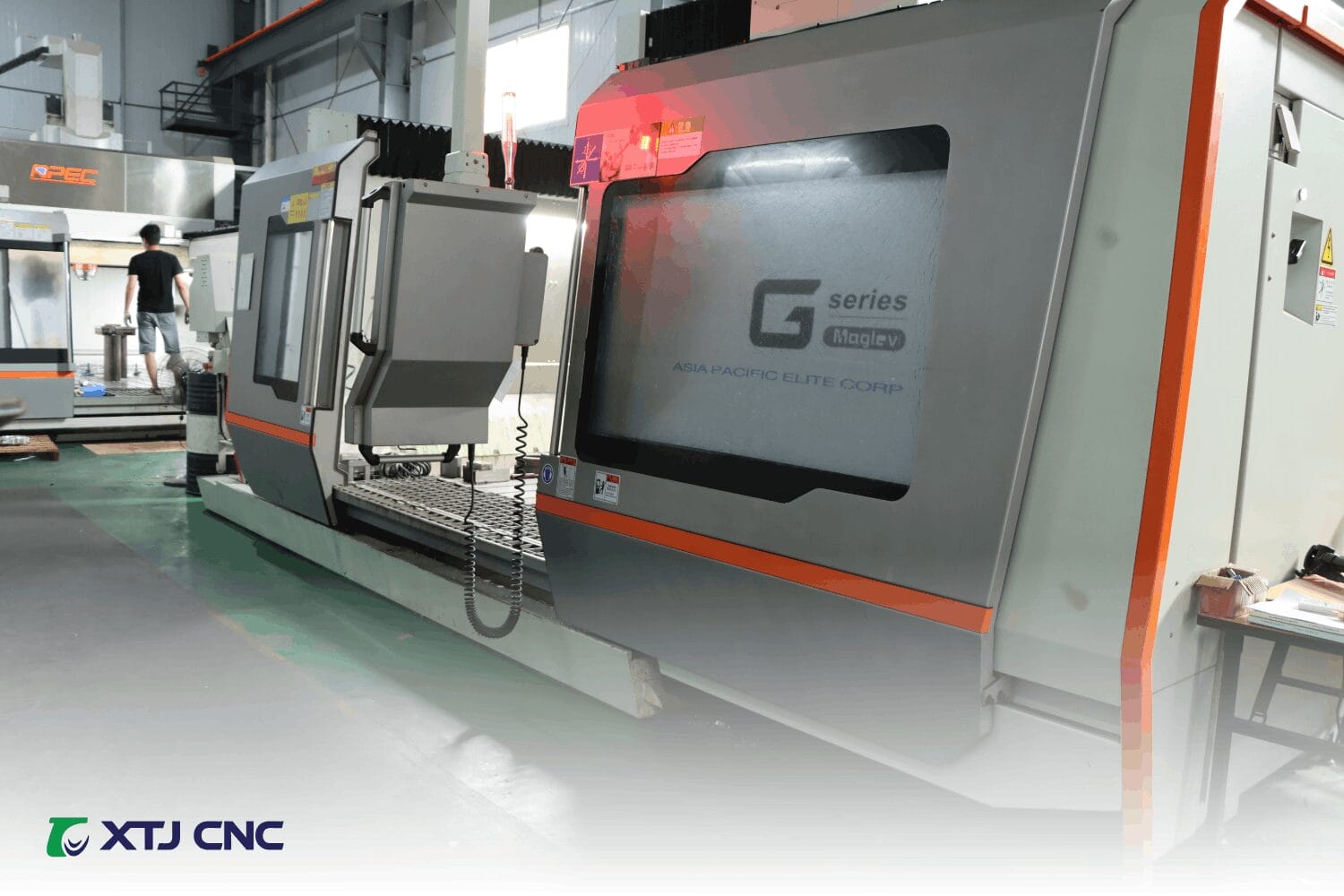
Most China-based CNC shops claim 5-axis capability. The harder question is what kind. There’s a significant difference between a shop running simultaneous contouring on a DMG Mori and one tilting a trunnion table to a fixed angle and calling it “5-axis.” Both require a 5-axis machine. Only one can handle complex contoured geometries without multiple setups. Buyers who don’t know the difference end up with parts that don’t meet spec—or quotes that don’t reflect what the job actually requires.
The 5-axis CNC machining centers market was valued at roughly $4.7 billion in 2025 and is growing at around 6% annually. China accounts for a significant share of that growth, and the number of shops claiming multi-axis capability has expanded accordingly. This guide cuts through the noise. We’ve evaluated 10 China-based 5-axis CNC machining providers on equipment investment, simultaneous vs. 3+2 capability, tolerance specs, material range, and certifications—so you can shortlist with confidence.
What 5-Axis CNC Machining Makes Possible
On a standard 3-axis mill, the cutting tool moves along X, Y, and Z. That covers prismatic parts with accessible top-side features. The moment your geometry involves undercuts, compound-angle pockets, or contoured surfaces curving in multiple directions, you’re looking at multiple setups, multiple fixtures, and positional error that stacks with every re-clamp.
A 5-axis machine adds two rotary axes—typically A and B, or B and C, depending on configuration. When all five axes move simultaneously during cutting, the tool approaches the workpiece from virtually any angle in a single setup. Impeller blades, complex pump housings, structural brackets with compound angles, optical lens mounts – these all benefit from 5-axis because the alternative is four or five setups on a 3-axis machine, each one introducing fresh positional error.
Fewer setups also compresses cycle time. Every re-fixturing adds 15 to 45 minutes of non-cutting time, before accounting for first-article re-verification after each clamp. For production batches, those minutes accumulate fast. On a complex part that would require five 3-axis setups, a single 5-axis operation often delivers a lower total cost per part despite the higher machine-hour rate.
Simultaneous 5-Axis vs. 3+2: The Distinction Most Guides Skip
This is the single most important filter when evaluating a China-based 5-axis shop—and most competitor roundups never address it.
3+2 machining (positional 5-axis): Two rotary axes tilt the workpiece or spindle to a fixed angle, lock there, and then perform standard 3-axis cutting. Useful for accessing multiple faces without re-clamping and allows shorter, more rigid tools for efficient material removal. The rotary axes don’t move during cutting. It’s capable and widely used – just not the same as simultaneous contouring.
Simultaneous 5-axis machining: All five axes move during the cut. Tool orientation adjusts continuously relative to the workpiece surface, which is what complex contoured geometries require. This demands better machine rigidity, higher-quality rotary drives, more sophisticated CAM programming, and operators who understand rotary tool center point control (RTCP/TCPC).
5+1 axis: Five interpolated axes plus an additional indexing axis, often a rotary table. Extends the working envelope for large or asymmetric parts without changing the fundamental simultaneous-vs.-positional distinction above.
A shop running 3+2 on a mid-range trunnion table does useful work. It isn’t the same as simultaneous contouring on a DMG Mori or Hermle, and the parts your job produces will reflect that. When you’re evaluating shops, ask directly: “Do you run simultaneous 5-axis, 3+2, or both?” If a supplier can’t answer clearly, treat that as a meaningful data point.
Comparison Table: Top 10 5-Axis CNC Machining Shops in China
Use this table for initial filtering. Lead times are estimates for standard orders and vary by part complexity, material, and current shop capacity.
| Shop | Location | 5-Axis Type | Tolerance | Key Materials | Certifications | Lead Time |
|---|---|---|---|---|---|---|
| XTJ CNC | Dongguan | Simult. + 3+2 | ±0.003 mm | Al, SS, Ti, Inconel | ISO 9001, IATF 16949 | 5 days (proto) |
| RapidDirect | Shenzhen | Simult. + 3+2 | ±0.005 mm | 50+ metals/plastics | ISO 9001, ISO 13485 | 3–7 days |
| WayKen | Shenzhen | Simult. + 3+2 | ±0.005 mm | Al, SS, Ti, plastics | ISO 9001 | 3–5 days (proto) |
| 3ERP | Zhongshan | 3+2, simult. | ±0.005 mm | Al, SS, Cu, plastics | ISO 9001, ISO 14001 | 5–7 days |
| ECOREPRAP | Shenzhen | Simult. + 3+2 | ±0.005 mm | Al, SS, Ti | ISO 9001 | 5–10 days |
| Runsom | Zhongshan | 3+2, simult. | ±0.005 mm | Al, SS, Cu, Ti | ISO 9001 | 7–14 days |
| Zintilon (ZTL) | Dongguan | Simult. + 3+2 | ±0.005 mm | Al, SS, plastics | ISO 9001, IATF 16949 | 5–7 days |
| AT-Machining | Shenzhen | 3+2, simult. | ±0.005 mm | Al, SS, Ti, Inconel | ISO 9001 | 7–14 days |
| Yijin Solution | Shenzhen | Simult. + 3+2 | ±0.005 mm | Al, SS, Cu, plastics | ISO 9001 | 5–10 days |
| Leadrp | Shenzhen | 3+2, simult. | ±0.01 mm | Al, SS, plastics | ISO 9001 | 3–5 days (proto) |
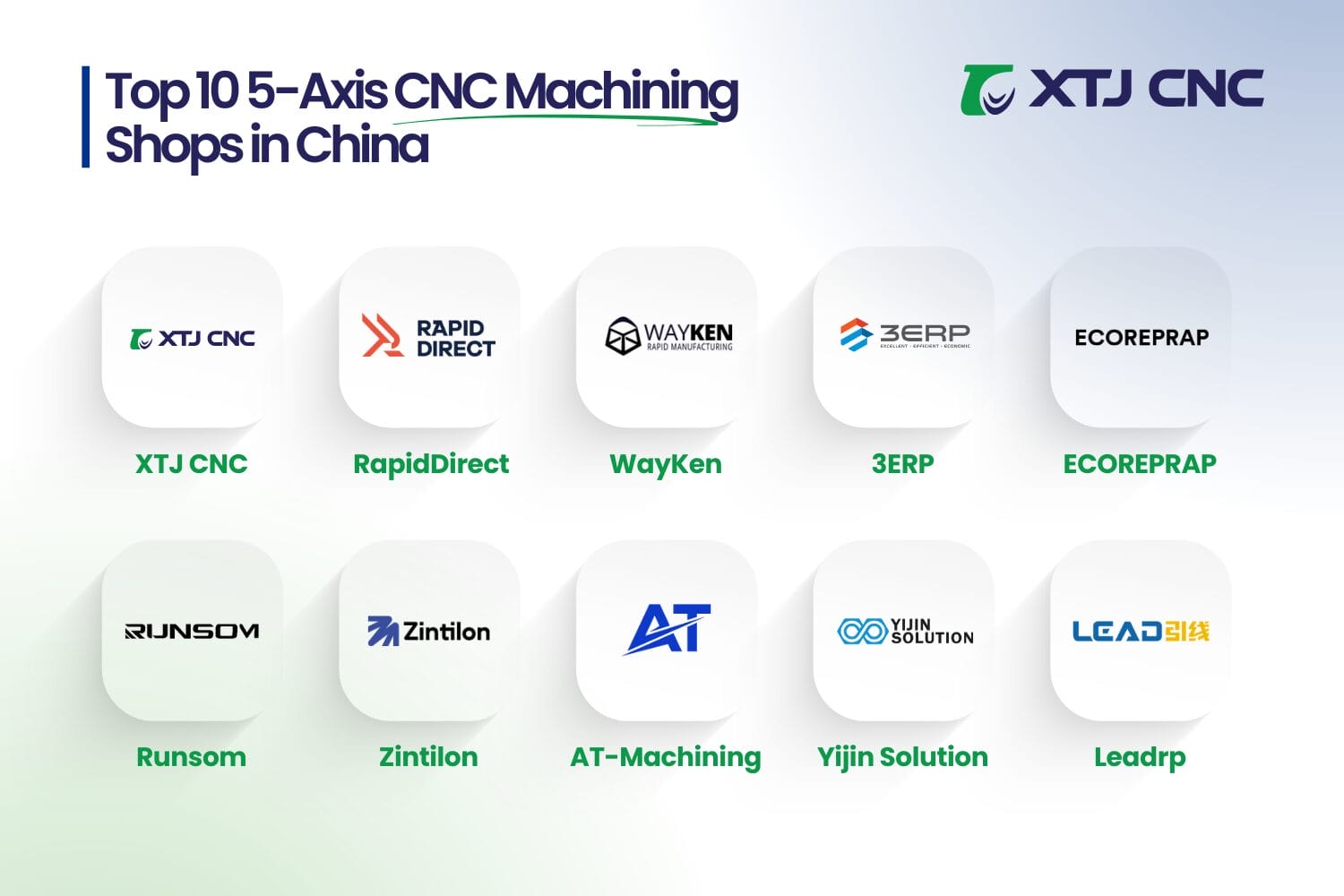
Top 10 5-Axis CNC Machining Shops in China
1. XTJ CNC
XTJ CNC operates a 12,000 m² facility in Dongguan with 120+ CNC machines spanning 3-axis through full simultaneous 5-axis milling, turning, and turn-milling centers. With 20+ years in custom CNC machining, the company has built a track record across automotive, medical device, electronics, and industrial equipment manufacturing.
Tolerance capability sits at ±0.003 mm across milling and turning operations—the tightest figure on this list—backed by CMM inspection with full material traceability. ISO 9001 and IATF 16949 certification mean automotive-grade process control applies to every order, whether the material is aluminum, stainless steel, titanium, or Inconel. Prototypes ship in as few as five days; standard production orders typically deliver within 10 to 15 days. There’s no MOQ, and every new part receives a free DFM review before production begins. For projects combining machined and formed components, XTJ CNC’s sheet metal fabrication services run through the same facility.
Suited to: Simultaneous 5-axis work in demanding materials, automotive and medical supply chains, and buyers who need ±0.003 mm precision with IATF 16949 documentation.
2. RapidDirect
RapidDirect operates from a 5,000 m² facility in Shenzhen and functions as a digitally driven manufacturing platform rather than a traditional machine shop. Founded in 2019, they offer instant online quoting and automated DFM feedback through a polished web interface, with production handled through in-house capacity and a network of vetted partner facilities.
Their 5-axis service covers simultaneous and 3+2 work across 50+ materials, including metals and engineering plastics, with tolerances to ±0.005 mm. Maximum part size reaches 4,000 × 1,500 × 600 mm. ISO 9001 and ISO 13485 certifications position them for general industrial and medical device work. The tradeoff: you may not always know which facility cuts your parts. For buyers who want direct shop-floor access, confirm which partner facility handles your specific project before committing.
Suited to: Platform-driven ordering, fast quoting, broad material range, and buyers who prioritize digital workflow convenience over direct supplier relationships.
3. WayKen
WayKen Rapid Manufacturing, headquartered in Shenzhen since 2013, focuses on rapid prototyping and on-demand production with a deliberate prototype-to-production pipeline. Their 5-axis capability covers aluminum, stainless steel, titanium, and engineering plastics with tolerances of ±0.005 mm. Prototype lead times start at three days for straightforward geometries.
The practical differentiator is service breadth alongside 5-axis: vacuum casting, rapid tooling, and injection molding are available under the same roof. For product development teams that need to go from a machined prototype to a molded short run without switching suppliers, WayKen’s integrated model reduces coordination overhead and compresses the timeline.
Suited to: Rapid prototyping, prototype-to-molding transitions, and buyers who need 5-axis machining as part of a broader product development workflow.
4. 3ERP
3ERP, based in Zhongshan, has been providing rapid prototyping and low-volume manufacturing since 2015. They run both 3+2 and simultaneous 5-axis machining across aluminum, stainless steel, copper, brass, and a range of engineering plastics. ISO 9001 and ISO 14001 certified, with prototype lead times of five to seven days for standard geometries.
ISO 14001 environmental certification is uncommon among China-based CNC shops and may matter for buyers with supply chain sustainability reporting requirements. 3ERP is a solid choice for straightforward 5-axis prototype work across a wide material range. For high-volume production in difficult alloys, confirm capacity and production capability directly before committing.
Suited to: Prototype and low-volume 5-axis work, broad material range, buyers with environmental certification requirements in their supply chain.
5. ECOREPRAP
ECOREPRAP is a Shenzhen-based CNC machining provider that has built a clear reputation around communication discipline. Project managers are required to hold recognized English proficiency certifications; quoting engineers must have at least five years of machining experience. For buyers sending complex 5-axis drawings overseas, the quality of the person reading that drawing matters as much as the machine cutting it.
They support simultaneous 5-axis machining across aluminum, stainless steel, and titanium with ±0.005 mm tolerances. ISO 9001 certified, with full First Article Inspection Reports (FAIR) provided as standard and regular production updates throughout the job. Lead times run five to 10 days for typical projects.
Suited to: Buyers for whom clear communication and structured documentation are as important as machining precision – particularly teams new to overseas 5-axis sourcing.
6. Runsom
Runsom Precision, based in Zhongshan, offers CNC machining alongside sheet metal fabrication and surface finishing under one roof. Their 5-axis capability covers both 3+2 and simultaneous work, with tolerances of ±0.005 mm across aluminum, stainless steel, copper, titanium, and several plastics. ISO 9001 certified.
Runsom sits at a competitive price point—on the lower end of the range for China-based 5-axis work. Lead times run seven to 14 days for standard projects. The integrated machining and finishing model is the practical draw for mid-complexity parts where you need cutting, forming, and surface treatment without managing multiple vendors. Runsom reduces the supplier count without a significant premium.
Suited to: Mid-complexity 5-axis parts requiring integrated machining and finishing, cost-sensitive procurement, and buyers who want to minimize vendor count.
7. Zintilon (ZTL)
Zintilon, headquartered in Dongguan, provides CNC machining, sheet metal fabrication, and 3D printing. They hold both ISO 9001 and IATF 16949—placing them in the smaller group of China-based 5-axis shops with automotive-grade quality systems alongside XTJ CNC. Their 5-axis capability covers simultaneous and 3+2 work with tolerances of ±0.005 mm across aluminum alloys, stainless steels, and engineering plastics.
Dongguan’s deep local supply chain for raw materials and finishing consumables gives Zintilon a logistical advantage in lead time and material sourcing. Standard orders ship in five to seven days. For automotive and industrial component buyers who need IATF documentation but don’t require the tightest tolerance tier on this list, Zintilon is a well-priced alternative to the top two entries.
Suited to: Automotive supply chains requiring IATF 16949, 5-axis work in aluminum and stainless steel, and buyers who need dual machining and sheet metal capability.
8. AT-Machining
AT-Machining has been operating out of Shenzhen since 2007, offering CNC machining, sheet metal fabrication, and wire EDM. They run both 3+2 and simultaneous 5-axis work with tolerances of ±0.005 mm across aluminum, stainless steel, titanium, and Inconel. ISO 9001 certified.
Long operational tenure and a material list that includes Inconel signal genuine experience with difficult-to-machine alloys—not just a broad capability claim. Wire EDM adds a process dimension most 5-axis shops on this list don’t offer: for parts requiring precision profiles, slots, or features that milling can’t cleanly produce, having EDM in-house removes a subcontracting step. Lead times typically fall in the seven-to-14-day range.
Suited to: Complex parts needing 5-axis machining plus wire EDM, difficult-to-machine alloys including Inconel, and buyers who value long supplier tenure.
9. Yijin Solution
Yijin Solution is a Shenzhen-based precision machining specialist with a focused service model: custom CNC machining for metals and plastics, without spreading attention across every adjacent process. Their 5-axis milling capability holds tolerances to ±0.005 mm with surface finishes down to Ra 0.8 µm on metals. Material coverage spans aluminum, stainless steel, copper, brass, and engineering plastics. ISO 9001 certified, with lead times of five to 10 days.
The specialist focus is the practical advantage. Shops that run fewer service lines develop deeper process knowledge on the ones they offer. For buyers whose primary need is precision 5-axis machined parts—without requiring sheet metal, casting, or molding from the same supplier—Yijin’s concentrated capability is worth evaluating.
Suited to: Precision-focused 5-axis machining across metals and plastics, buyers who want a specialist rather than a generalist, Ra 0.8 µm surface finish requirements.
10. Leadrp
Leadrp, based in Shenzhen, is built for speed. Prototype lead times starting at three days make them one of the fastest options on this list. They run both 3+2 and simultaneous 5-axis across aluminum, stainless steel, and engineering plastics, with tolerances of ±0.01 mm for standard work—tighter on request. ISO 9001 certified.
The speed premium comes at a cost: Leadrp’s pricing sits toward the higher end of the China-based 5-axis range. For projects where the timeline is the binding constraint and the budget has flexibility, that tradeoff is straightforward. Confirm achievable tolerances for your specific geometry before committing—±0.01 mm is the standard production tolerance, and not all geometries qualify for the tighter tier.
Suited to: Fast-turn 5-axis prototypes, timeline-constrained projects, buyers for whom speed justifies a pricing premium.
What Suppliers Claim vs. What You Should Actually Ask
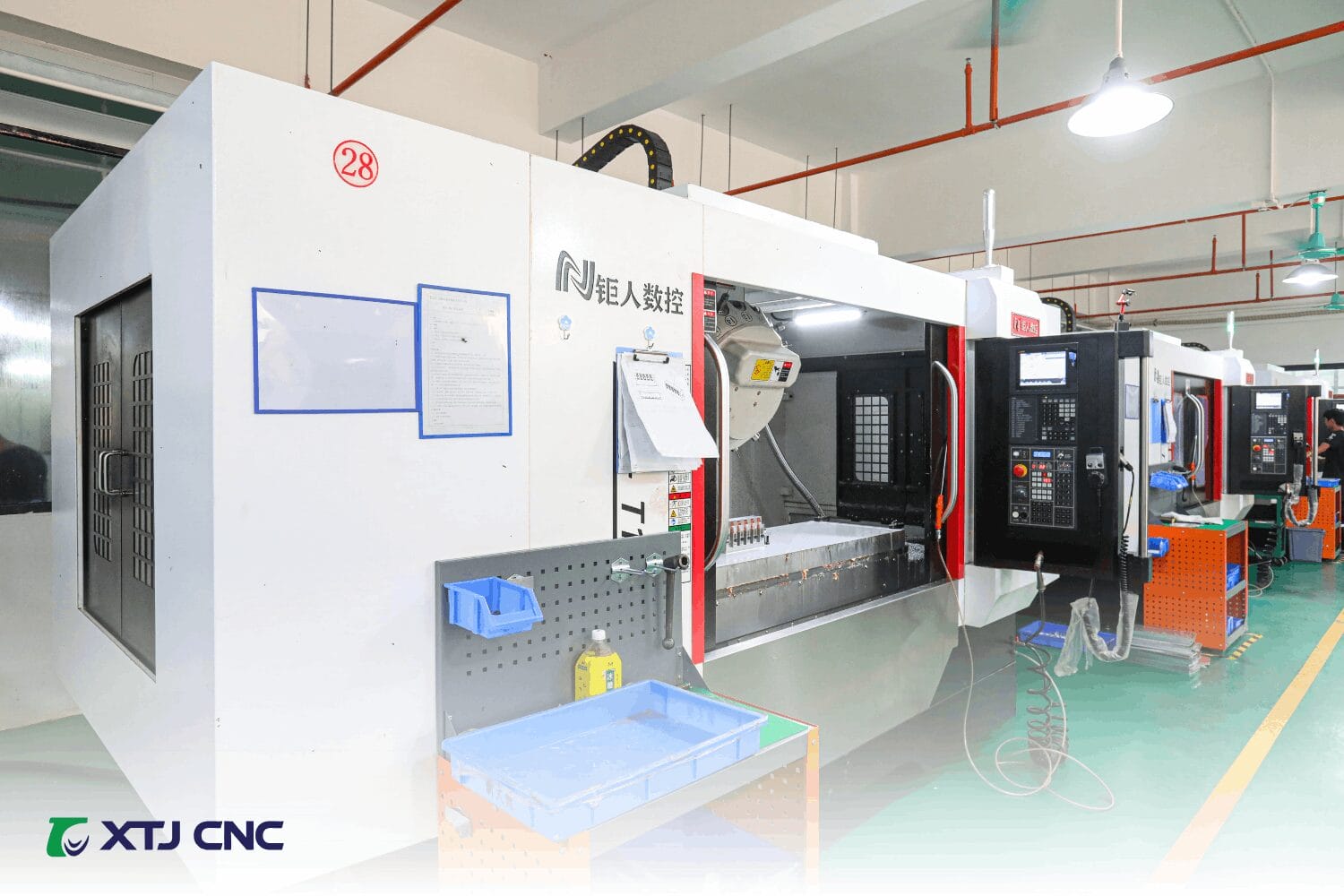
According to Global Growth Insights, roughly 62% of manufacturers are shifting toward multi-axis systems to improve precision and reduce setup time. That adoption wave means more shops claiming 5-axis capability than ever, which makes proper evaluation more important, not less. The table below maps common supplier claims to the questions that actually reveal capability.
| Evaluation Area | What Suppliers Claim | What to Actually Ask |
|---|---|---|
| 5-axis type | “Full 5-axis capability” | Do you run simultaneous contouring or 3+2 positional? Which jobs go on which machines? |
| Tolerance | “Tight tolerances” or “high precision” | What tolerance do you hold in production on 316L stainless or Ti-6Al-4V? Can you share CMM data from a comparable job? |
| Equipment | “Advanced CNC machines” or “latest equipment” | Which machine brands and models run 5-axis work? How many simultaneous 5-axis machines do you operate? |
| Materials | “50+ materials available” | Which difficult-to-machine alloys have you run in production? Can you show finished parts in titanium or Inconel? |
| DFM support | “Engineering support included” | Will you review my drawing before quoting and flag cost-driving features? Is that in writing before I commit? |
| Certifications | “ISO certified” | What is your certification number and scope? Is it ISO 9001 only, or do you hold IATF 16949 or ISO 13485? |
*Use these questions in your first supplier call. The quality of the answers tells you more about a shop’s real capability than anything on their website.*
How does XTJ CNC’s Multi-Axis Capability Compare?
XTJ CNC sits at the precision end of the spectrum among China-based 5-axis shops. Three things set the position:
- Tolerance depth: ±0.003 mm across milling and turning operations is the tightest published specification on this list. That figure is backed by CMM inspection with traceable calibration – not a marketing claim. For complex geometries in titanium or Inconel where a missed tolerance means a rejected batch rather than a cosmetic issue, the inspection infrastructure behind that number matters.
- Certification for regulated industries: IATF 16949 is uncommon among China-based 5-axis shops. For automotive supply chains where the quality management system – not just the part – has to meet audit requirements, XTJ CNC’s certification removes a qualification hurdle that most competitors on this list can’t clear.
- Full-service integration: The 120+ machine fleet spans 3-axis through simultaneous 5-axis, with sheet metal fabrication in the same facility. For projects that combine machined components with formed sheet metal—enclosures, brackets, structural assemblies—single-source production removes handoff risk and compresses lead time.
If you’re evaluating 5-axis shops for an upcoming project, upload your design files for a free quote and DFM review from XTJ CNC. Pricing and engineering feedback come back within 24 hours.
FAQs on 5-Axis CNC Machining Shops
How does 5-axis machining affect per-part cost compared to 3-axis?
Machine-hour rates for 5-axis work run 30 to 60% higher than 3-axis because of equipment investment and programming complexity. However, 5-axis often reduces total per-part cost on geometries that would otherwise require multiple setups. Each re-fixturing on a 3-axis machine adds 15 to 45 minutes of non-cutting time, plus the risk of positional error, scrap, and re-inspection. For parts with features on three or more faces, a single 5-axis setup is frequently faster and cheaper overall than running three or four 3-axis operations in sequence.
How much does 5-axis CNC machining cost in China compared to the US or Europe?
Hourly shop rates for 5-axis work in China typically run $40 to $80 per hour, compared to $75 to $150+ for equivalent capability in North America or Western Europe. The cost difference comes from lower labor costs, facility overhead, and supply chain depth—not from differences in machine quality. Many China-based 5-axis shops run the same DMG Mori, Mazak, and Hermle equipment as Western shops, backed by ISO and IATF certifications.
What’s the largest part size a typical China 5-axis shop can handle?
This varies significantly by shop. Some providers accommodate parts up to 4,000 × 1,500 × 600 mm on their largest 5-axis centers. Most 5-axis work involves parts in the 50 to 500 mm range. Parts outside that envelope may require bridge-type or gantry-style 5-axis machines, which fewer shops operate. Confirm maximum part dimensions early in the quoting process – don’t assume.
Can 5-axis machining achieve mirror finishes on metals?
Simultaneous 5-axis machining achieves surface finishes down to Ra 0.2 to 0.4 µm on aluminum and stainless steel with appropriate tooling and finishing strategies. The 5-axis advantage is that the tool maintains an optimal contact angle with the surface throughout the cut, producing more consistent starting finishes before any secondary polishing. Mirror-quality finishes below Ra 0.1 µm typically require electropolishing or mechanical polishing as a secondary operation.
How do you verify a China 5-axis shop’s capability before placing an order?
Request sample parts or reference projects within your material and complexity range—not generic portfolio shots. Ask for CMM inspection reports from comparable jobs with actual measured values against nominal dimensions. Confirm specific machine brands and models. If the shop can’t tell you which machines run their simultaneous 5-axis work, that’s worth noting. A free DFM review of your actual part files, with specific engineering feedback rather than generic approval, is the strongest live capability signal available without a factory visit.
Back to Top: Top 10 5-Axis CNC Machining Shops in China (2026)