Brass is one of the most machinable metals in production – and that accessibility is exactly what makes supplier selection harder than it looks. When most CNC shops across Guangdong claim proficiency with C360, the differences that actually matter get buried behind similar-sounding capability lists. Alloy expertise, RoHS compliance, and tolerance consistency at volume don’t show up in a brochure.
This guide cuts through that. Below you’ll find 10 vetted brass CNC machining manufacturers in China, each assessed on the criteria engineers and procurement teams care about most: alloy range, tolerance capability, certifications, finishing options, and compliance handling. The global brass market is projected to grow at around 5% annually through 2033, with Asia-Pacific accounting for over 40% of production volume. China’s share – concentrated in Guangdong, Zhejiang, and Jiangsu – means more options than ever. More options also means more homework. This list reduces it.
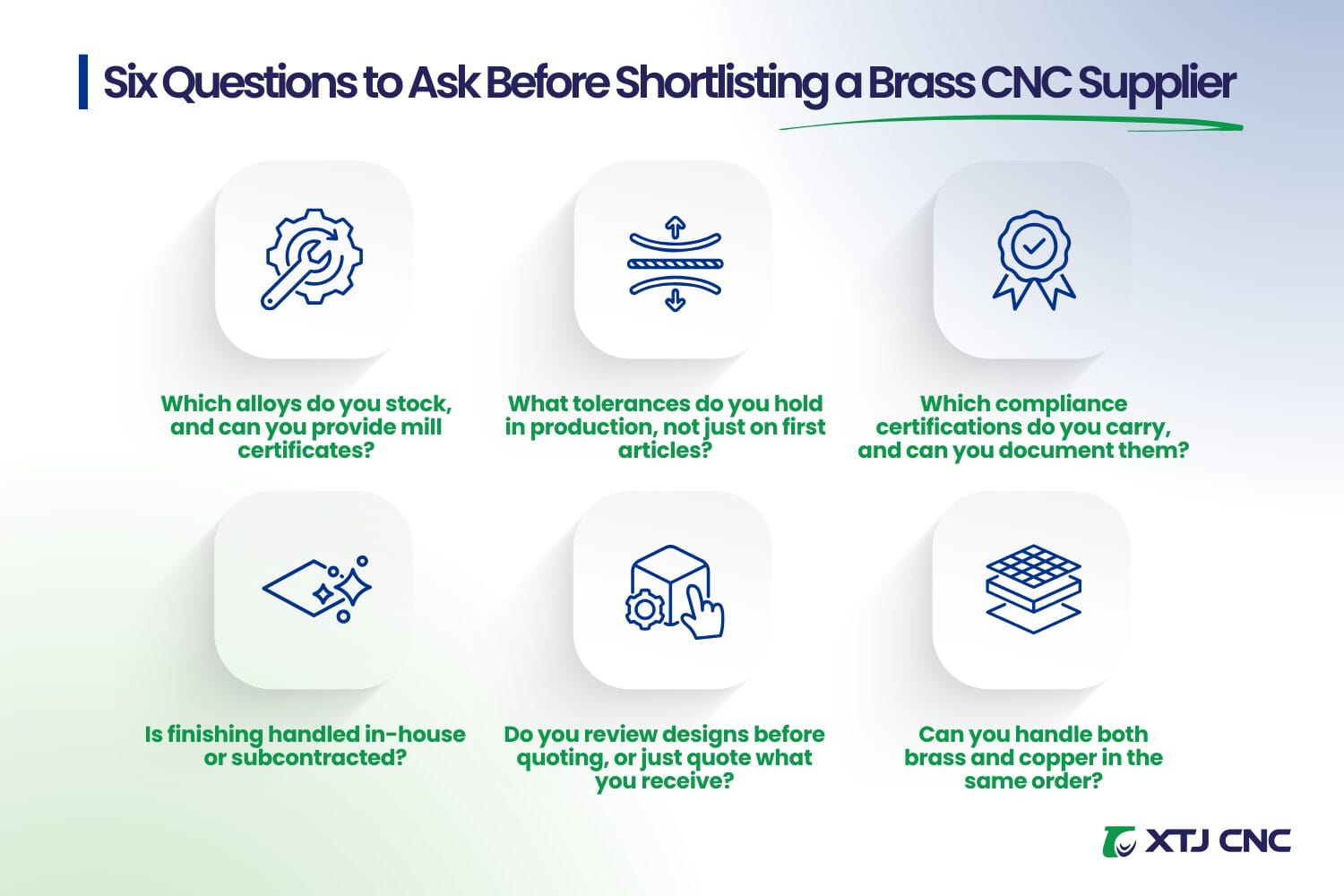
Six Questions to Ask Before Shortlisting a Brass CNC Supplier
These aren’t tick-box items – they’re the questions where supplier answers actually tell you something.
- Which alloys do you stock, and can you provide mill certificates? A supplier that only carries C360 can handle straightforward jobs. One that stocks C385, C464, and lead-free grades like C693 signals deeper material expertise. Mill certificates should be standard, not a special request.
- What tolerances do you hold in production, not just on first articles? Standard brass CNC tolerances sit around ±0.05 mm. Precision brass work – connector pins, valve seats, instrument fittings – often requires ±0.01 mm or tighter. The distinction between first-article capability and production consistency is where many suppliers fall short.
- Which compliance certifications do you carry, and can you document them? ISO 9001 is the baseline. IATF 16949 matters for automotive components. RoHS and REACH documentation are non-negotiable for electronics and EU-export parts. Ask for the certificate number and verify it independently.
- Is finishing handled in-house or subcontracted? Brass parts frequently need nickel plating, chrome plating, electropolishing, or lacquer coating. In-house finishing compresses lead time and removes a quality handoff point. Outsourced finishing adds days and introduces handling damage risk between facilities.
- Do you review designs before quoting, or just quote what you receive? A supplier that flags unnecessarily tight tolerances on non-critical surfaces, deep internal bores, and complex threading – before you’re committed to production – is a manufacturing partner. One that quotes silently and delivers surprises later is not.
- Can you handle both brass and copper in the same order? Common in electrical and thermal management applications. Brass and copper machines differently – copper requires slower feeds and different tooling geometry to avoid smearing. Confirm the supplier has specific experience with both, not just a claim of material range.
Comparison Table: Top 10 Brass CNC Machining Manufacturers in China
Use this table for initial filtering. Lead times reflect standard production orders. Alloy availability and certification details should be confirmed directly with each supplier before placing an order.
| Company | Location | Key Brass Grades | Certifications | Lead Time | Standout Capability |
|---|---|---|---|---|---|
| XTJ CNC | Dongguan | C360, C385, lead-free | ISO 9001, IATF 16949 | 5–15 days | Free DFM, no MOQ, ±0.003 mm |
| Yijin Solution | Shenzhen | C360, C260 | ISO 9001 | 5–20 days | Swiss machining, free design consultation |
| HM (HMaking) | Shenzhen | C360, C260, C385 | RoHS, SDWA compliant | 7–18 days | Triple-layer QC, 5-axis, lead-free |
| VMT (ViMetal) | Shenzhen | C360, C270 | ISO 9001, IATF 16949 | 7–18 days | 25+ yrs experience, in-house finishing |
| RapidDirect | Shenzhen | C360, C260 | ISO 9001 | 3–15 days | Instant quoting, scalable production |
| 3Q Machining | Dongguan | C360, C110 (copper) | ISO 9001 | 5–15 days | 2-hr quoting, Ra ≤0.1 µm |
| Anebon | Shenzhen | C360, C280 | ISO 9001, RoHS/REACH | 7–18 days | ±0.002 mm precision turning |
| Worthy Hardware | Dongguan | C360, C385, C464, C485 | ISO 9001 | 7–20 days | Naval brass, the widest alloy range |
| Machmaster | Guangdong | C360, C260, C464 | ISO 9001 | 7–18 days | Marine-grade finishing, C464 specialist |
| CNCFirst | Shenzhen | C360, C353 | ISO 9001 | 7–18 days | Competitive bulk pricing |
Top 10 Brass CNC Machining Manufacturers in China
1. XTJ CNC
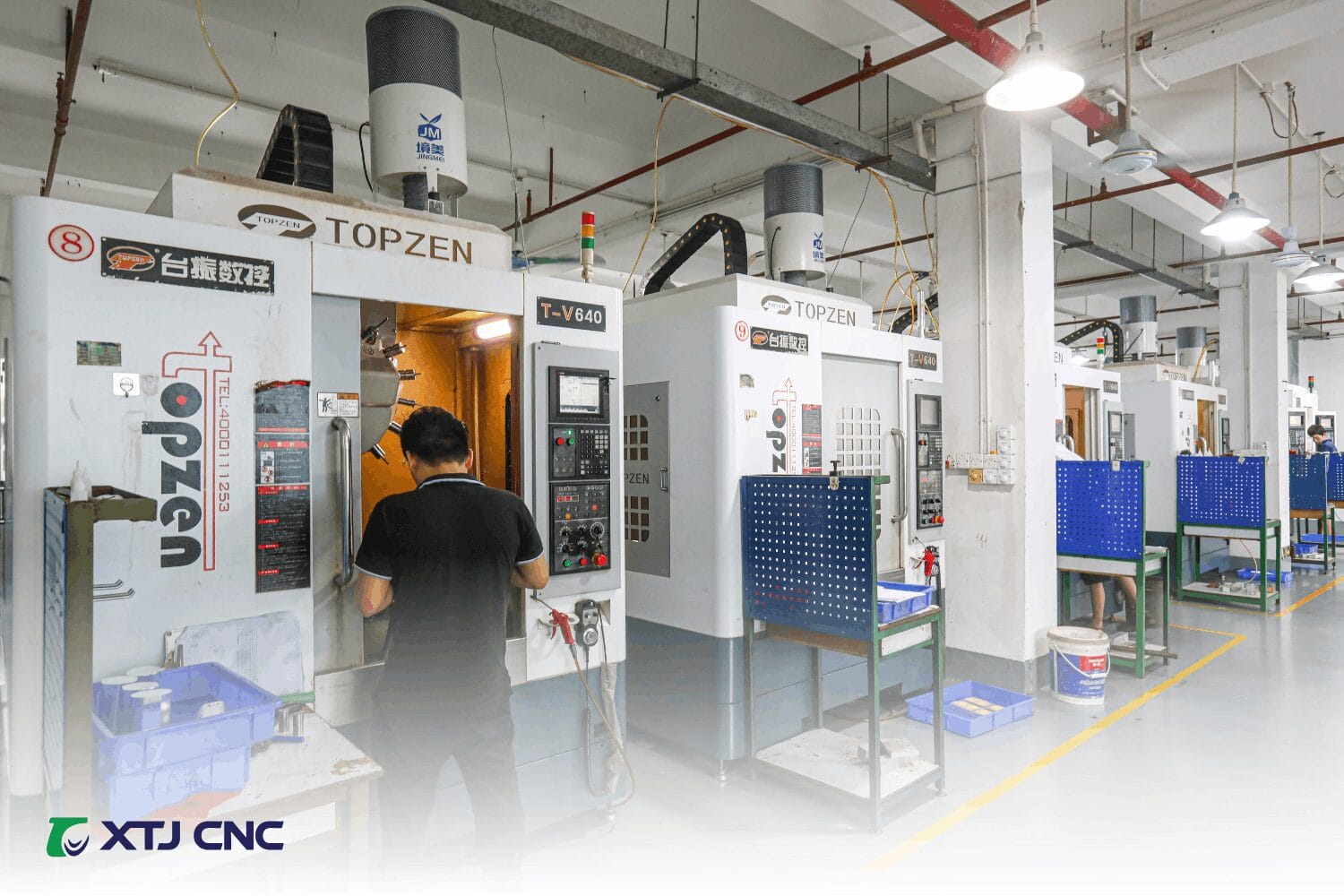
XTJ CNC operates a 12,000 m² facility in Dongguan with 120+ machines spanning 3-axis to 5-axis CNC milling, turning, and turn-milling. Brass machining covers C360, C385, and lead-free alloys, with tolerances down to ±0.003 mm verified through CMM inspection. ISO 9001 and IATF 16949 certification means automotive-grade process discipline applies to every order – whether you’re running 10 prototype connector housings or 5,000 production valve bodies. There’s no minimum order quantity, and every new part receives a free DFM review with engineering feedback delivered alongside the quote. Full details on their machining capabilities are available on the XTJ CNCmachining page.
Finishing is handled in-house: nickel plating, chrome plating, electropolishing, and lacquer coating are all available without outsourcing. Material traceability runs from stock receipt through delivery documentation. For buyers sourcing brass parts that need to meet automotive or regulated industry requirements, XTJ CNC’s combination of precision, certification, and flexible ordering is the strongest on this list.
Prototype lead times run as few as five days; standard production orders typically ship within 10 to 15 days.
Industries served: Automotive, electronics, industrial equipment, and medical devices.
Suited to: Buyers who need automotive-grade certification, tight tolerances, and in-house finishing on brass parts – with no MOQ and free DFM review built into every order.
2. Yijin Solution
Based in Shenzhen, Yijin Solution brings two decades of CNC machining and rapid prototyping experience. Brass machining covers C360 and C260 grades across CNC turning, Swiss machining, and milling. Free design consultations are included in the quoting process, which is useful for buyers working through first-time brass part sourcing. ISO-certified quality processes and an established export presence across North American and European markets give them credibility with overseas procurement teams.
Prototype turnaround runs five to seven days. Bulk production orders typically ship within 10 to 20 days. Swiss machining capability makes them a reliable option for small-diameter brass turned parts where conventional lathes struggle with rigidity.
Industries served: Automotive, electrical, and machinery.
Suited to: prototype speed and design consultation support for new-to-brass buyers.
3. HM (HMaking)
HM, based in Shenzhen, specializes in precision brass CNC parts with a stated zero-defect quality policy backed by a triple-layer inspection process. Brass grades covered include C360, C260, and C385, with 5-axis machining for complex geometries, Swiss turning for small-diameter pins and contacts, and turn-milling for mixed-feature parts.
RoHS and Safe Drinking Water Act compliance is built into their brass work – not an add-on. That makes them a practical choice for plumbing fittings bound for the EU or potable water systems. Surface finishing options include nickel plating, chrome plating, and high-polish finishes, all handled in-house.
Industries served: Plumbing, electronics, and automotive.
Suited to: RoHS-sensitive applications, lead-free brass parts, buyers who need rigorous inspection documentation.
4. VMT (ViMetal)
Shenzhen-based VMT (ViMetal) brings 25+ years of CNC machining experience, with brass parts forming a significant share of their production output. They work primarily with C360 and C270 grades across CNC milling, turning, and in-house finishing. VMT holds both ISO 9001 and IATF 16949 – the same automotive-grade certification as XTJ CNC – making them one of only two IATF-certified brass machining shops on this list.
Their experience shows in handling complex brass geometries: deep bores, thin-wall sections, and multi-feature connector housings. For buyers who need a supplier with a long operational history, stable processes, and automotive quality documentation, VMT is worth a closer look.
Industries served: Automotive, marine, and electronics.
Suited to: complex brass geometries, IATF-required supply chains, buyers prioritizing operational track record.
5. RapidDirect
RapidDirect operates an automated quoting platform that delivers pricing within hours of CAD file upload. For engineers managing multiple concurrent projects, that turnaround compresses the sourcing cycle significantly. Brass machining covers C360 and C260 across CNC milling, turning, and various post-processing options, with scalable production handling prototypes and mid-volume runs within the same workflow.
Pricing sits at the higher end for low-volume prototype work – the convenience premium is real. For buyers who value platform speed and straightforward order management over negotiated pricing, RapidDirect is a practical choice for non-critical brass parts.
Industries served: Consumer electronics, industrial, and medical.
Suited to: instant quoting, platform-managed ordering, scalable production without supplier relationship overhead.
6. 3Q Machining
3Q Machining, based in Dongguan, offers precision brass CNC machining with tolerances down to ±0.005 mm and a two-hour quote turnaround – the fastest on this list. They work with C360 and C110 (pure copper), covering CNC turning, milling, and Swiss machining. Surface roughness down to Ra ≤0.1 µm is achievable on turned brass features.
The dual brass and copper capability is the practical differentiator. For buyers sourcing both materials – common in electrical and thermal management applications – 3Q’s confirmed experience with copper machining (not just brass) means fewer suppliers to manage and consistent communication across both material types.
Industries served: Electronics, plumbing, and industrial.
Suited to: fast quoting cycles, combined brass and copper orders, precision turned parts requiring Ra ≤0.1 µm.
7. Anebon
Anebon is an ISO 9001-certified CNC turning specialist in Shenzhen focused on high-precision brass parts. Working with C360 and C280, their tolerance capability reaches ±0.002 mm on turned features – the tightest specification on this list outside XTJ CNC – with surface roughness down to Ra ≤0.1 µm. RoHS and REACH compliance documentation comes standard with every order.
Beyond standard turning and milling, Anebon offers CNC grinding and wire EDM for parts requiring features that conventional machining can’t produce cleanly. For precision connector components, medical terminals, and instrument fittings where dimensional accuracy and compliance documentation are both non-negotiable, Anebon is a strong fit.
Industries served: Electronics, automotive, and medical.
Suited to: demanding tolerance requirements, RoHS/REACH documentation needs, parts requiring wire EDM or grinding alongside turning.
8. Worthy Hardware
Worthy Hardware, based in Dongguan, offers the widest alloy range on this list. Beyond standard C360 and C385, they machine C464 (naval brass) and C485 (leaded naval brass) – grades that few competitors carry. That breadth makes them the practical choice for marine hardware, pump components, and fittings exposed to saltwater or high-humidity environments where standard brass grades corrode prematurely.
Capabilities include 5-axis machining, CNC turning, and milling with tolerances appropriate for precision industrial parts. If your project spans both standard and specialty brass grades within a single product line, Worthy’s alloy depth reduces the supplier count.
Industries served: Marine, industrial, and plumbing.
Suited to: naval brass applications, wide alloy range requirements, harsh-environment components.
9. Machmaster
Machmaster operates in Guangdong province with 15+ years of brass CNC machining experience. Brass grades covered include C360, C260, and C464, with services spanning turning, milling, and in-house surface finishing: nickel plating, chrome plating, sandblasting, and polishing. ISO 9001 certified with documented incoming inspection, in-process checks, and final verification.
Their marine-grade brass finishing capability – specifically C464 naval brass with corrosion-resistant surface treatment – positions them for outdoor, marine, and high-humidity applications. A practical second-source option for buyers who already work with Worthy Hardware and want redundancy on naval brass supply.
Industries served: Marine, plumbing, and decorative hardware.
Suited to: marine-grade brass components, corrosion-resistant finishing, buyers needing C464 expertise.
10. CNCFirst
CNCFirst, based in Shenzhen, competes on cost and production volume. They work with C360 and C353 (high-leaded brass), and their pricing structure is built for bulk runs. For buyers sourcing thousands of simple turned brass fittings or fasteners where per-unit cost is the primary driver, CNC First’s lean model delivers.
Alloy range and finishing options are narrower than most competitors’ higher on this list. They’re not the right call for complex multi-feature parts, tight tolerances below ±0.01 mm, or compliance-sensitive applications. For straightforward, high-volume brass turned work, they’re a cost-efficient option worth getting a quote from.
Industries served: Plumbing, general industrial, and consumer goods.
Suited to: high-volume brass turning, cost-driven procurement, straightforward part geometries.
Why Brass is the Benchmark Material for CNC Machining
Brass isn’t just popular – it’s the literal industry benchmark. C360 free-cutting brass carries a machinability rating of 100%, the standard set by the Copper Development Association against which every other copper alloy is measured. That rating translates to concrete shop-floor advantages: faster spindle speeds, longer tool life, cleaner chip formation, and surface finishes that often need no secondary polishing.
Beyond machinability, brass offers a combination of properties few metals match at its price point. Corrosion resistance in moisture-heavy and mildly chemical environments. Dezincification resistance in certain grades for prolonged saltwater exposure. Electrical conductivity well-suited to connectors and terminals. A natural antimicrobial quality increasingly relevant in plumbing and food-contact applications. Density between aluminum and steel – parts feel substantial without the weight of ferrous alloys.
The cost efficiency case is straightforward. A valve body that takes 12 minutes to turn in C360 might take 30 to 35 minutes in 316L stainless and wear out your inserts twice as fast. Fewer finishing passes, shorter cycle times, and less aggressive tooling requirements mean lower per-part cost on comparable geometry – which is why brass remains the default choice for high-volume turned components across plumbing, electronics, and automotive applications.
Brass Alloys: Which Grade is Right for Your Application?
The alloy you specify affects machinability, corrosion resistance, lead content, RoHS status, and per-part cost. Picking the wrong grade means compliance problems, performance gaps, or unnecessary expense. Here’s a comparison of the grades you’re most likely to encounter when sourcing from China. Full composition and property data are available through the Copper Development Association.
| Alloy | Composition (approx.) | Key Properties | Machinability | Common Applications |
|---|---|---|---|---|
| C360 (Free-Cutting) | 61.5% Cu, 35.5% Zn, 3% Pb | High strength, corrosion-resistant | 100% (benchmark) | Valves, fittings, connectors, fasteners |
| C353 (High-Leaded) | 61% Cu, 35% Zn, 4% Pb | Superior chip control | >100% | Swiss-turned pins, intricate small parts |
| C385 (Architectural) | 57% Cu, 40% Zn, 3% Pb | Good strength, attractive finish | ~100% | Decorative hardware, handrails, trim |
| C260 (Cartridge) | 70% Cu, 30% Zn | High ductility, no lead | ~30% | Stamped components, deep-drawn shells |
| C464 (Naval) | 60% Cu, 39% Zn, 0.8% Sn | Excellent saltwater resistance | ~30% | Marine hardware, pump shafts |
| C693 (Lead-Free) | Cu-Zn-Bi-Se | RoHS compliant, near-C360 performance | ~90 to 95% | Plumbing (potable water), EU-export parts |
C360 is the default for most turned and milled brass parts. If your application has no specific lead restrictions or marine exposure requirements, it’s almost always the right starting point. C385 shares similar machining characteristics but offers a more visually appealing finish, making it popular for architectural and decorative components.
Lead content becomes a hard constraint for EU export and potable water applications. C360 and C385 both contain roughly 3% lead. For RoHS-compliant or Safe Drinking Water Act-compliant parts, specify C693 (bismuth-selenium brass) or another certified lead-free alternative. These grades cost 25 to 30% more than C360 but eliminate the regulatory exposure entirely.
How XTJ CNC Handles Brass Parts
Three things separate XTJ CNC’s brass machining from a general-purpose shop that accepts brass jobs.
Process discipline from the first quote: Every new brass part gets a free DFM review before production begins. The engineering team examines your design for features that drive cost without adding function – unnecessary tolerances on non-critical surfaces, deep bores in thin-wall sections, thread specifications that force manual operations. Changes flagged at this stage cost nothing. Changes discovered mid-production cost time and money.
Certification that actually means something for brass: IATF 16949 is uncommon among China-based brass machining shops. For buyers supplying automotive customers, having a certified supplier in the chain isn’t optional – it’s an audit requirement. XTJ CNC’s quality management system meets that standard as a default, not as a premium service tier.
Finishing under one roof: Nickel plating, chrome plating, electropolishing, and lacquer coating are all handled in-house. No outsourced finishing steps means tighter lead time control and direct quality accountability across the complete production process – from raw bar stock to finished, inspected parts ready to ship.
If you’re evaluating brass CNC machining partners and want engineering feedback before committing to production, request a free DFM review and quote from XTJ CNC. Pricing and design review come back within 24 hours.
FAQs on Brass CNC Machining Manufacturers in China
Is C360 brass RoHS compliant?
Not by default. C360 contains approximately 3% lead, which exceeds the RoHS directive’s 0.1% limit for lead in homogeneous materials. RoHS exemptions exist for specific applications: copper alloys with up to 4% lead are permitted for certain electrical and mechanical uses. If full RoHS compliance is required without relying on exemptions, specify a lead-free alloy like C693 or ECO Brass. Your supplier should provide material test reports confirming lead content alongside the shipment.
What tolerances can brass CNC machining realistically achieve?
Standard machining tolerances for brass sit around ±0.05 mm, which most CNC shops hold without special effort. Precision brass work – connector pins, instrument fittings, valve seats – commonly calls for ±0.01 mm to ±0.005 mm. Below ±0.005 mm typically requires Swiss-type turning or precision grinding with controlled-environment inspection. When requesting tight tolerances, confirm that the supplier holds them in production runs, not just on a first-article sample, and that their inspection setup supports the measurement at that level.
What surface finishes are available for CNC-machined brass parts?
Brass accepts a wide range of finishes depending on the application. Nickel plating adds wear resistance and a silver-toned appearance, common for electrical connectors and consumer hardware. Chrome plating provides additional hardness and stronger corrosion protection for wear or moisture exposure. Electropolishing delivers a smooth, hygienic surface for food-contact or medical-adjacent components. For decorative parts, high-polish mechanical finishing achieves near-mirror results without plating, while clear lacquer preserves brass’s natural gold tone for display-quality work. Confirm whether finishing is handled in-house or subcontracted – in-house typically means shorter lead times and less handling damage risk.
Can one supplier handle both brass and copper CNC machining?
Yes, but the machining characteristics differ significantly. Brass – especially C360 – produces clean, brittle chips and machines at high speeds. Pure copper (C110) is softer and gummier, requiring different tooling geometry, slower feed rates, and more aggressive coolant strategies to avoid smearing and burr formation. If you need both, confirm the supplier has specific production experience with copper machining, not just a claimed material range. 3Q Machining on this list explicitly handles both.
Back to Top: Top 10 Brass CNC Machining Manufacturers in China (2026)