Stainless steel is one of the least forgiving materials in CNC machining. The moment a cutting tool rubs rather than shears, the material work-hardens, and a supplier without a disciplined coolant strategy and chip-load control will burn through inserts, miss tolerances, and cost your project weeks of rejected parts.
That failure mode is entirely avoidable with the right manufacturing partner. The problem is that most China-based CNC shops will tell you they machine stainless steel. What they don’t advertise is whether they’ve optimized their processes for it – or whether they’re running aluminum parameters and hoping the material cooperates. For grades like 316L and 17-4 PH, that difference shows up in scrapped batches and missed delivery windows.
This guide ranks the top 10 stainless steel CNC machining manufacturers in China for 2026. Each supplier has been evaluated on material grade range, tolerance capability, certifications, finishing options, and demonstrated experience with 303, 304, 316L, and 17-4 PH. Whether you’re sourcing food-grade stainless parts, marine hardware, or precision medical components, use this list to build a shortlist you can qualify with confidence.
How to Evaluate a China Stainless Steel CNC Supplier
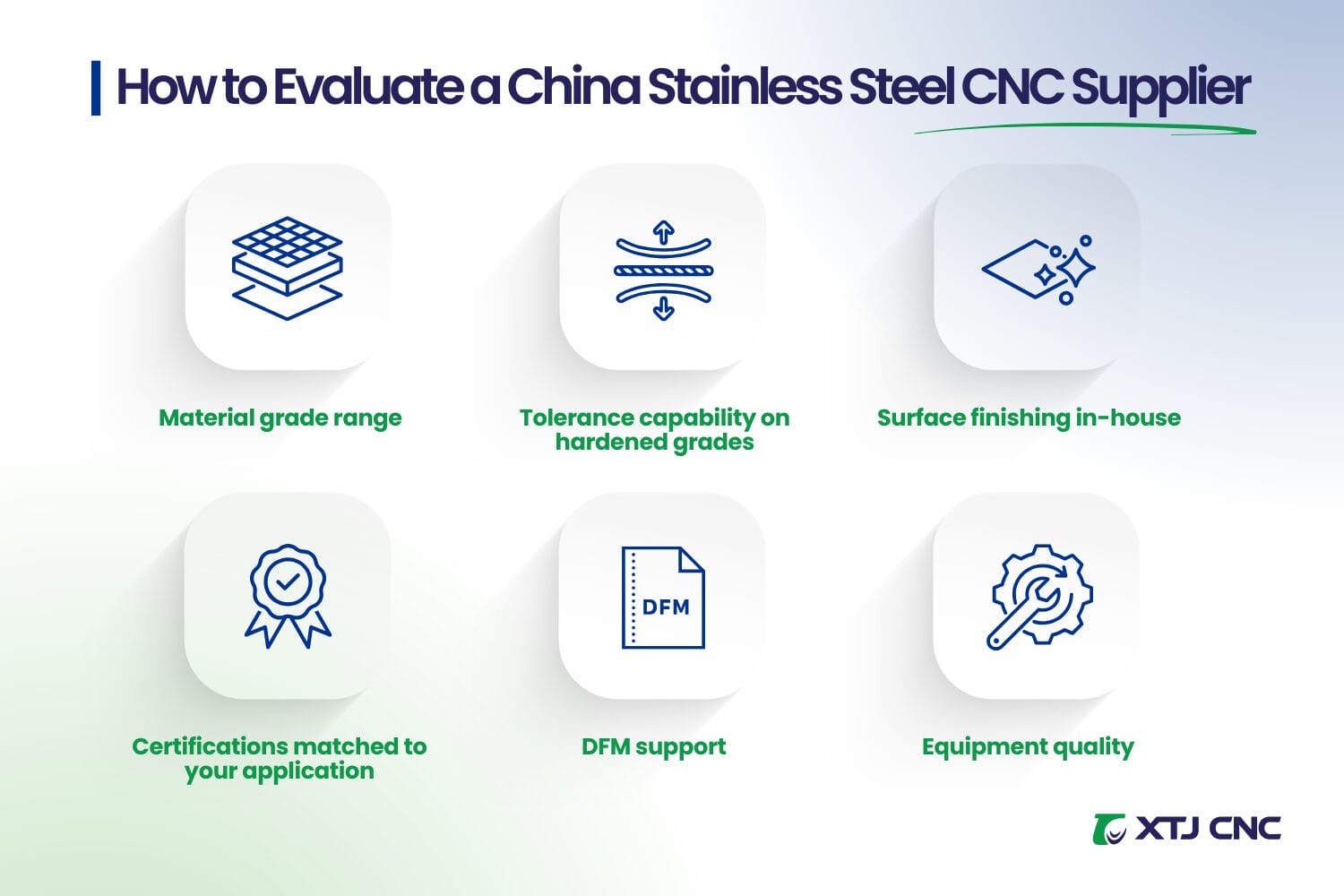
Six criteria that should take less than a minute each to verify during initial supplier screening:
- Material grade range: Can they handle 303, 304, 316L, and 17-4 PH without hesitation? Ask which grades they run most frequently – frequency signals genuine expertise, not just listed capability.
- Tolerance capability on hardened grades: Standard CNC tolerances (±0.05 mm) are baseline. For stainless steel, ask specifically about achievable precision on 316L and 17-4 PH. Anything below ±0.01 mm requires temperature-controlled environments and dedicated process controls.
- Surface finishing in-house: Passivation, electropolishing, bead blasting, and mirror finish (Ra ≤0.4 µm) are common requirements. Confirm these are handled in-house – outsourced finishing adds lead time and introduces additional quality handoff risk.
- Certifications matched to your application: ISO 9001 is mandatory. IATF 16949 matters for automotive supply chains. ISO 13485 is required for medical components. Ask for the certificate number and verify it independently.
- DFM support: A good stainless steel supplier reviews your drawing before quoting and flags features that drive cost: deep pockets in 316L, unnecessarily tight tolerances on non-critical surfaces, internal corner radii that force small-diameter endmills.
- Equipment quality: Machines from DMG Mori, Mazak, Haas, and Fanuc indicate genuine investment in precision. Multi-axis capability (4-axis and 5-axis) reduces setups on complex stainless parts, which directly reduces work-hardening risk.
Comparison Table: Top Stainless Steel CNC Manufacturers in China
The table below summarizes key capabilities across all 10 suppliers. Use it for initial filtering before requesting detailed quotes. Lead times reflect standard production orders; prototype and expedited timelines will differ.
| Manufacturer | Location | SS Grades | Tolerance | Certifications | Lead Time |
|---|---|---|---|---|---|
| XTJ CNC | Dongguan | 303, 304, 316L, 17-4 PH | ±0.003 mm | ISO 9001, IATF 16949 | 5 – 15 days |
| Gensun Precision | Dongguan | 303, 304, 316, 316L | ±0.01 mm | ISO 9001 | 7 – 20 days |
| HLH Prototypes | Shenzhen | 304, 316L | ±0.01 mm | ISO 9001 | 5 – 12 days |
| Star Rapid | Zhongshan | 304, 316, 17-4 PH | ±0.01 mm | ISO 9001, ISO 14001 | 7 – 15 days |
| DEK Manufacturing | Shenzhen | 303, 304, 316L | ±0.01 mm | ISO 9001 | 7 – 18 days |
| WayKen | Shenzhen | 304, 316, 316L | ±0.01 mm | ISO 9001 | 5 – 15 days |
| Runsom Precision | Dongguan | 303, 304, 316L, 17-4 PH | ±0.01 mm | ISO 9001 | 7 – 20 days |
| Davantech | Dongguan | 304, 316, 316L | ±0.01 mm | ISO 9001 | 10 – 20 days |
| CNCFirst | Shenzhen | 303, 304, 316L | ±0.01 mm | ISO 9001 | 7 – 15 days |
| VMT CNC | Shenzhen | 303, 304, 316L, 17-4 PH | ±0.01 mm | ISO 9001, IATF 16949 | 7 – 20 days |
Top 10 Stainless Steel CNC Machining Manufacturers in China
1. XTJ CNC
XTJ CNC operates a 12,000 m² facility in Dongguan with 120+ machines spanning 3-axis to 5-axis CNC milling, turning, and turn-milling. Founded in 2005, the company has two decades of stainless steel machining experience across 303, 304, 316L, and 17-4 PH. Tolerances reach ±0.003 mm – the tightest figure on this list – and the finishing line covers passivation, electropolishing, bead blasting, and precision surface treatments handled entirely in-house. For a full overview of their process range, see XTJ CNC’s CNC machining services.
IATF 16949 certification sets XTJ CNC apart from most mid-sized Chinese CNC shops on this list. Combined with a no-MOQ policy, it means automotive-grade process discipline applies whether you’re ordering 10 prototypes or 5,000 production parts. Every new project receives a free DFM review, and CMM inspection with full material traceability is standard across all stainless steel orders.
Why buyers choose XTJ CNC: IATF 16949 certification, ±0.003 mm tolerance on stainless, in-house finishing including electropolishing, free DFM review, no MOQ, prototypes in as few as five days.
2. Gensun Precision Machining
Based in Dongguan and founded in 2006, Gensun is an ISO 9001-certified CNC machining provider with a team of 51 to 200 employees. Their stainless steel capability covers 303, 304, 316, and 316L, alongside aluminum, brass, and engineering plastics. Work spans prototype manufacturing through small-batch production, primarily for clients in North America and Europe.
Gensun’s reputation is built on consistency rather than speed. For buyers who need reliable quality on recurring stainless steel orders without premium rapid-turnaround pricing, they’re a steady option with established Western client communication processes.
Why buyers choose Gensun Precision Machining: Mid-range pricing, consistent quality on repeat orders, and familiar communication standards for North American and European procurement teams.
3. HLH Prototypes
HLH Prototypes operates from a 12,000 m² facility across Shenzhen and Dongguan, housing 150+ machines. The company has served over 3,000 customers globally for over 15+ years. CNC machining capabilities include 3-, 4-, and 5-axis work in 304 and 316L stainless steel.
The operation is structured around prototyping speed. Fast first-article turnaround and low-volume batch capability are their primary strengths. If stainless steel prototypes are on a tight timeline and a slight speed premium is acceptable, HLH’s production infrastructure supports it.
Why buyers choose HLH Prototypes: Large-scale prototyping capacity, fast lead times, well-established global client base with a strong communication infrastructure.
4. Star Rapid
Star Rapid, established in 2005 in Zhongshan, Guangdong, combines CNC machining with vacuum casting and injection molding for a multi-process manufacturing capability. ISO 9001 and ISO 14001 certified, with CMM verification and full inspection documentation. Stainless steel material range covers 304, 316, and 17-4 PH.
Star Rapid operates in the premium tier. Higher overhead and a structured quality management system make them a fit for buyers whose stainless steel parts require full traceability and documentation for regulated industries. ISO 14001 environmental certification is uncommon among Chinese CNC shops and may matter for buyers with supply chain sustainability requirements.
Why buyers choose Star Rapid: Full traceability, multi-process manufacturing (CNC plus casting and molding), ISO 14001 environmental certification, and regulated industry documentation requirements.
5. DEK Manufacturing
DEK is a Shenzhen-based CNC machining specialist producing precision metal and plastic parts. Stainless steel machining covers 303, 304, and 316L grades across milling and turning. Engineering support is a genuine part of their service model; they’ll work through design challenges with you rather than quoting a drawing as-submitted.
Their work spans electronics, industrial automation, and general engineering applications. DEK is a dependable mid-range supplier with solid turnaround times and responsiveness well-suited to iterative development programs.
Why buyers choose DEK Manufacturing: Strong engineering support, fast delivery, versatile across metals and plastics, and good communication cadence for iterative design projects.
6. WayKen Rapid Manufacturing
WayKen, founded in 2013 and headquartered in Shenzhen, provides rapid prototyping and on-demand manufacturing services. Their ISO 9001-certified facility handles CNC machining in 304, 316, and 316L stainless steel, with capabilities spanning CNC prototyping, 5-axis precision machining, and low-volume production.
WayKen’s differentiator is optical prototyping capability alongside traditional CNC. For buyers who need cosmetic-quality stainless steel parts, where surface appearance carries as much weight as dimensional accuracy, that combined capability reduces the vendor count on appearance-critical projects.
Why buyers choose WayKen Rapid Manufacturing: Optical prototyping alongside CNC, 5-axis precision capability, and rapid manufacturing for appearance-critical and low-volume stainless steel parts.
7. Runsom Precision
Located in Dongguan, Runsom provides precision CNC machining for complex geometries and tight-tolerance components. Their stainless steel range covers 303, 304, 316L, and 17-4 PH – one of the broader grade selections on this list. Both milling and turning are supported with multi-axis capability.
Runsom is a practical choice for buyers whose projects span multiple stainless grades within a single product line. Willingness to machine 17-4 PH alongside standard austenitic grades signals genuine material capability rather than a generalist claim.
Why buyers choose Runsom Precision: Broad stainless grade range, including 17-4 PH, complex geometry machining, mid-range pricing with solid tolerance control.
8. Davantech
Davantech is a Dongguan-based, ISO 9001-certified CNC machining factory founded in 2012 and still operated by its Belgian founder. Western quality expectations are built into the operation from the ground up rather than applied as a compliance layer over a standard Chinese workflow. Stainless steel machining covers 304, 316, and 316L.
Buyers consistently report fewer miscommunication issues with Davantech than with comparable China-based shops. Documentation practices are thorough, and outcomes are predictable. Pricing reflects the premium positioning, but for first-time China sourcing, where communication risk is a genuine concern, that premium buys real peace of mind.
Why buyers choose Davantech: European ownership and quality standards, thorough documentation, and a lower communication risk for buyers new to China-based sourcing.
9. CNCFirst
CNCFirst is a Shenzhen-based manufacturer offering CNC milling, turning, and Swiss machining services for stainless steel parts. Material coverage includes 303, 304, and 316L. Swiss machining capability makes them particularly relevant for small-diameter stainless components – medical pins, threaded inserts, precision shafts – where conventional milling and turning struggle with rigidity and runout control.
Positioned as a budget-friendly option for buyers who need solid stainless steel machining quality without premium pricing. A practical choice for cost-sensitive projects where specifications don’t require tolerances tighter than ±0.01 mm.
Why buyers choose CNCFirst: Budget-friendly pricing, Swiss machining for small-diameter stainless parts, and reliable mid-tolerance production work.
10. VMT CNC
VMT CNC operates from a 5,000+ m² facility in Shenzhen, providing multi-material CNC machining services. ISO 9001 and IATF 16949 certified – making them one of only two suppliers on this list with automotive-grade process certification alongside XTJ CNC. Stainless steel range includes 303, 304, 316L, and 17-4 PH.
VMT has positioned stainless steel CNC machining as a core capability rather than an add-on. They’ve invested in the equipment and process documentation required for automotive, medical device, and industrial automation clients where quality records are non-negotiable.
Why buyers choose VMT CNC: IATF 16949 certification, broad stainless grade range, and mature process documentation for automotive and medical supply chains.
Why Stainless Steel CNC Machining Demands a Specialist
Most metals let you get away with average parameters. Stainless steel punishes the average. The austenitic grades – 304, 316, 316L – have a property that sets them apart from aluminum or mild steel: when the cutting edge compresses rather than cleanly shears, the chromium-nickel matrix undergoes plastic deformation at the grain boundary level. The surface hardens. Your next pass is cutting into the material measurably harder than the material you started with.
This is work hardening, and it’s the primary reason stainless steel machining costs more and goes wrong more often than other materials. A supplier running 304 parameters on 316L – which has higher nickel content (10 to 14% vs. 8 to 10.5% in 304) and work-hardens faster – will see surface hardness increase by 20 to 30% in a single pass if chip load drifts too low.
Compounding the problem: stainless steel has low thermal conductivity. Heat doesn’t evacuate through the chip the way it does in aluminum. It concentrates on the cutting edge, accelerating flank wear, and shortening insert life. Surface speeds for austenitic stainless typically sit around 60 to 120 m/min with coated carbide – roughly a third of what you’d run on 6061 aluminum.
A specialist stainless steel CNC factory runs rigid setups, aggressive feeds that stay ahead of the hardened layer, high-pressure coolant, and coated carbide or cermet tooling matched to the grade. A generalist shop might quote cheaper and deliver scrap.
Which Stainless Steel Grades Matter for CNC Machining?
Not all stainless steel machines the same way. The grade you specify determines tooling strategy, achievable surface finish, and per-part cost. Here are the four grades you’ll encounter most when sourcing from China. For detailed alloy data, ASM International’s stainless steel reference provides comprehensive composition and property tables.
303 (free-machining austenitic): Added sulfur improves machinability significantly, making it the easiest austenitic grade to cut and the default choice for high-volume turned parts like fittings, shafts, and fasteners. The tradeoff: slightly lower corrosion resistance than 304, and it’s not recommended for welded assemblies.
304 (the workhorse): The most widely specified stainless steel grade across industries. Good corrosion resistance, decent formability, and broad material availability. It machines reasonably well with proper parameters, though it work-hardens more readily than 303. Typical applications include food processing equipment, architectural hardware, and general industrial components.
316L (marine and medical grade): Molybdenum content of 2 to 3% gives 316L superior chloride corrosion resistance – essential for marine hardware, surgical instruments, and chemical processing. That same molybdenum makes the material “gummier” to cut. Machinability rating drops to around 36% relative to free-machining steel. Expect higher cycle times and more aggressive tooling requirements compared to 304.
17-4 PH (precipitation-hardened): A high-strength grade heat-treatable to tensile strengths above 1,100 MPa. Used in valve components, pump shafts, and structural applications. Machining strategy depends on condition: annealed 17-4 PH cuts similarly to 304, but the hardened condition demands reduced speeds and careful tool engagement.
How XTJ CNC Approaches Stainless Steel Machining
The variables that cause most stainless steel machining failures are controllable. Here’s how XTJ CNC addresses each one.
Rigid setups and multi-axis machining
5-axis simultaneous machining reduces the number of setups on complex stainless steel parts. Fewer re-fixturings means less work-hardening exposure on previously machined surfaces and tighter positional accuracy across features. For parts with multiple precision faces or intersecting bores in 316L, this approach directly protects your tolerance budget.
Grade-specific process parameters
303, 316L, and 17-4 PH don’t share a program. Each grade gets its own speeds, feeds, chip load targets, and coolant strategy. 17-4 PH in the hardened condition demands reduced surface speeds and careful tool engagement angles that would be unnecessarily conservative on 304. Running grade-level parameters is the operational difference between a stainless steel specialist and a general machine shop.
In-house finishing
Passivation (per ASTM A967), electropolishing for food-grade and medical applications, and bead blasting are all handled within XTJ CNC’s facility. No outsourced finishing steps means tighter lead time control and direct quality accountability throughout the complete production process.
CMM inspection and full traceability
Every stainless steel order goes through documented dimensional inspection. Material certificates, CMM reports, and process records ship with every order. For medical and automotive buyers, this documentation isn’t a premium add-on; it’s a baseline expectation that XTJ CNC meets as standard.
If you’re evaluating stainless steel CNC machining partners and want engineering feedback before committing to production, request a free DFM review and quote from XTJ CNC. You’ll receive pricing and design optimization notes within 24 hours.
FAQs on Stainless Steel CNC Machining Manufacturers
Can CNC machining achieve a mirror finish on stainless steel?
Yes, but the process chain matters. CNC machining alone reaches surface roughness values around Ra 0.4 to 0.8 µm with proper finishing passes and sharp tooling. For a true mirror finish (Ra ≤0.1 µm), electropolishing is required as a secondary operation. Confirm whether your supplier handles this in-house; outsourced electropolishing adds lead time and introduces an additional quality control handoff.
When should you specify 316L instead of 304?
If your application involves chloride exposure, saltwater, or aggressive chemical environments, 316L is the right call. The same applies to medical implants and food-contact surfaces, where regulatory standards typically require it. For everything else, 304 provides strong general corrosion protection at a lower per-part cost. 316L’s reduced machinability means slower cycle times and higher insert consumption – costs you shouldn’t absorb unless your operating environment genuinely demands chloride resistance.
How do you vet a China-based stainless steel CNC supplier?
Start with three checks: verify their ISO certificate number independently (don’t rely on a PDF from the supplier), run a sample order in the specific stainless grade you need (not aluminum – stainless machining competence doesn’t transfer across materials), and review their inspection report format. A supplier that provides CMM reports with actual measured values against nominal dimensions is operating at a different level than one that sends a generic pass/fail certificate. Factory audits – virtual or in-person – are standard practice, and any credible supplier will accommodate them.
Is food-grade stainless CNC machining available from Chinese manufacturers?
Yes, 316L is the standard material for food-contact applications because of its corrosion resistance and non-reactive surface characteristics. Beyond material selection, the finishing process is critical. Food-grade parts typically require electropolishing to achieve a smooth, non-porous surface that resists bacterial adhesion.
What tolerances can stainless steel CNC machining realistically achieve?
Standard CNC machining delivers ±0.05 mm on stainless steel without special effort. With proper process controls, ±0.01 mm is achievable on most austenitic grades. Below that – ±0.005 mm or tighter – you’re in precision territory requiring temperature-controlled environments, specialized fixturing, and potentially grinding or honing as secondary operations.
Back to Top: Top 10 Stainless Steel CNC Machining Manufacturers in China (2026)