Brass auto parts sourcing has, for decades, meant one word: Jamnagar. The Gujarat-based cluster produces the majority of India’s brass exports and supplies connectors, valve bodies, and fuel system fittings to Original Equipment Manufacturers (OEMs) across five continents.
Over the last five years, a second sourcing corridor has matured: China’s CNC-focused brass machining ecosystem, built around multi-axis precision and tighter compliance frameworks. For procurement teams weighing their next Request for Quotation (RFQ), the question isn’t whether India or China can make the part. It’s the sourcing model that delivers the tolerance, certification, and lead time your specific application demands.
This guide breaks down both markets, profiles the five strongest brass auto parts manufacturers in each region, and provides a head-to-head decision framework on tolerance, certification, lead time, and cost.
China vs. India: Head-to-Head Comparison
The table below compares the two sourcing regions across the factors that matter most to automotive procurement teams. These are general ranges, not absolute rules. Individual suppliers in both regions can outperform or underperform their local norm.
| Factor | India (Jamnagar Cluster) | China (CNC Hubs) |
|---|---|---|
| Typical tolerances | ±0.02 to ±0.05 mm standard | ±0.005 to ±0.01 mm achievable |
| Primary process | Auto-turning, CNC turning | Multi-axis CNC milling + turning |
| Core alloys | IS 319 / C36000, limited lead-free | C36000, C38500, C69300 lead-free |
| Certifications | ISO 9001 (many shops) | ISO 9001, IATF 16949, RoHS, REACH |
| Minimum order quantity | Often 500 to 1,000+ units | Often no MOQ; prototype-friendly |
| Lead time | 2 to 4 weeks standard | 1 to 3 weeks; expedited prototyping |
| RoHS / lead-free | Available but requires vetting | Standard at established CNC shops |
| Finishing in-house | Limited; often outsourced | Nickel, chrome, passivation in-house |
| DFM support | Rare in smaller shops | Offered by most export-focused suppliers |
The comparison isn’t a clean “one is better” story. Jamnagar dominates on cost for simple, high-volume turned brass parts where ±0.03 mm tolerance is more than adequate. China wins when the geometry is complex, the tolerance is tight, the alloy needs to be lead-free, and the buyer needs IATF 16949 documentation for their quality file.
Manufacturer Comparison at a Glance
The table below profiles all 10 manufacturers covered in this article. Use it alongside the regional comparison above to narrow your shortlist based on capabilities that match your application.
| Company | Tolerance | Core Alloys | Certifications | Lead Time | RoHS |
|---|---|---|---|---|---|
| INDIA | |||||
| Saryu Industries | ±0.02 to ±0.05 mm | IS 319, C36000, custom | ISO 9001 | 2 to 4 wks | Request MTC |
| Shiv Om E-Tec | ±0.02 to ±0.05 mm | Brass (CNC turned) | ISO 9001 | 2 to 4 wks | Request MTC |
| Empire Alloy | ±0.02 to ±0.05 mm | Brass precision | ISO 9001:2000 | 2 to 4 wks | Request MTC |
| Aceforge | ±0.02 to ±0.05 mm | Forged brass | Not stated | 2 to 4 wks | Request MTC |
| Premier Brass | ±0.02 to ±0.05 mm | Standard brass | Not stated | 2 to 4 wks | Request MTC |
| Company | Tolerance | Core Alloys | Certifications | Lead Time | RoHS |
|---|---|---|---|---|---|
| CHINA | |||||
| XTJ CNC | ±0.003 mm | C36000, C38500, lead-free | ISO 9001, IATF 16949 | 1 to 3 wks | Standard |
| YIJIN Hardware | Standard CNC | C36000, C38500, Al bronze | ISO 9001 | 1 to 3 wks | Available |
| Dajin Precision | ±0.005 to ±0.01 mm | HPb63, HPb62, HPb59-1, H59, H62, H68 | Not stated | 1 to 3 wks | Available |
| HLC Metal Parts | ±0.01 mm | Brass, multi-material | Not stated | 1 to 3 wks | Available |
| MQJM CNC | Precision CNC | Brass turning alloys | Quality documented | 1 to 3 wks | Available |
Top Brass Auto Parts Manufacturers in India
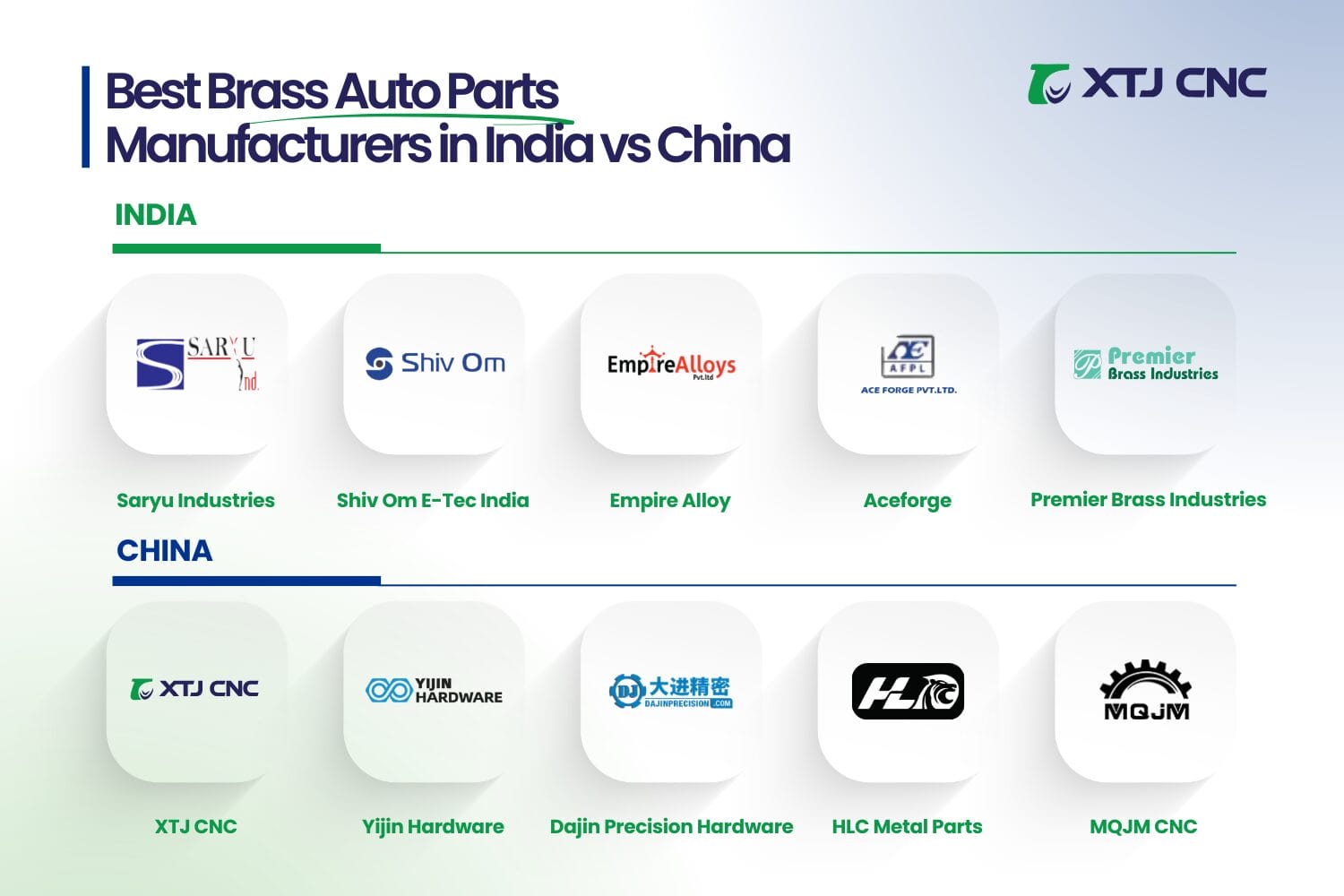
These five Indian manufacturers represent the strongest options within the Jamnagar brass ecosystem for automotive component sourcing. Selection criteria include export track record, certification level, alloy range, and production capacity.
1. Saryu Industries
Saryu Industries is based in Jamnagar, Gujarat, and specializes in brass automotive connectors, fuel system fittings, battery terminals, and plumbing hardware. Their material range covers IS 319, C36000, and custom alloy compositions, with ISO 9001 certification in place. Export reach spans the US, Europe, and the Middle East across multiple industries.
Their strength is in medium-to-high-volume turned components with documented export capability and a consistent quality record. For buyers sourcing standard brass auto connectors or fuel fittings at volume where ±0.02 to ±0.05 mm tolerance is adequate, Saryu is one of the more established names in the Jamnagar cluster.
Choose if: You need medium-to-high-volume IS 319 or C36000 brass connectors, fuel fittings, or terminals at competitive per-unit pricing, with ISO 9001-documented export capability.
2. Shiv Om E-Tec India Pvt. Ltd.
Shiv Om E-Tec operates out of Jamnagar, Gujarat, focusing on precision-machined brass auto components, terminal connectors, and brake system parts. ISO 9001 certified with CNC capability for brass turned parts. They serve automotive OEMs and Tier 1 suppliers with an emphasis on dimensional consistency and surface finish.
Their production model suits mid-volume runs where consistent quality on repeat orders matters more than prototype speed. Communication for export orders is well-established, and their focus on automotive-adjacent applications—brake systems, terminals—signals relevant process experience within the Jamnagar cluster.
Choose if: You’re sourcing mid-volume brass terminal connectors or brake system components for automotive Tier 1 supply and need ISO 9001 documentation with established export processes.
3. Empire Alloy Pvt. Ltd.
Empire Alloy is a Jamnagar-based manufacturer of brass precision turned parts, hydraulic fittings, automotive components, lock nuts, and reducers. ISO 9001:2000 certified, with a broad spectrum of brass precision components manufactured to buyer specifications. Export reach covers multiple continents.
Their differentiated strength is range: hydraulic fittings, lock nuts, reducers, and precision turned parts under one operation. For buyers who need a diversified brass component supplier – not just connectors and terminals – Empire Alloy’s broader product scope means fewer suppliers to manage across a complex automotive BOM.
Choose if: You need a Jamnagar supplier with a broader brass component range beyond standard connectors and terminals, covering hydraulic fittings, reducers, and machined-to-spec parts across multiple automotive applications.
4. Aceforge Pvt. Ltd.
Aceforge, based in Jamnagar, Gujarat, differentiates through its forging capability. Their specialties include forged brass automotive parts, valve components, and high-pressure fittings – applications where higher mechanical strength than standard turned components is the design requirement.
The forging-plus-machining workflow suits applications where structural integrity under vibration or pressure is a primary consideration. Forged brass parts have a denser grain structure than turned equivalents, which improves fatigue life under cyclic loading – relevant for high-pressure fuel system fittings and valve bodies in demanding environments.
Choose if: Your application requires forged brass components—valve bodies, high-pressure fittings, or structural automotive parts—where forged grain structure improves fatigue life beyond what turned components provide.
5. Premier Brass Industries
Premier Brass Industries operates from Jamnagar, Gujarat, serving both automotive and industrial markets with brass automobile parts, industrial valves, and electrical components. Custom brass components are produced against the buyer’s drawings with standard Jamnagar-grade tolerances.
Their product range covers fuel system hardware, electrical terminals, and general-purpose connectors. For cost-focused procurement of standard brass auto parts at volume—where complexity is low and Jamnagar-standard tolerances are sufficient—Premier Brass offers a practical, export-ready option without a premium overhead.
Choose if: You need a cost-competitive Jamnagar supplier for standard brass auto parts at volume—fuel hardware, electrical terminals, and general connectors—where standard tolerances are sufficient and per-unit cost is the primary driver.
Top Brass Auto Parts Manufacturers in China
China’s brass CNC machining landscape includes dozens of capable suppliers. These five stand out for automotive buyers based on precision capability, certification depth, alloy range, and export track record.
1. XTJ CNC
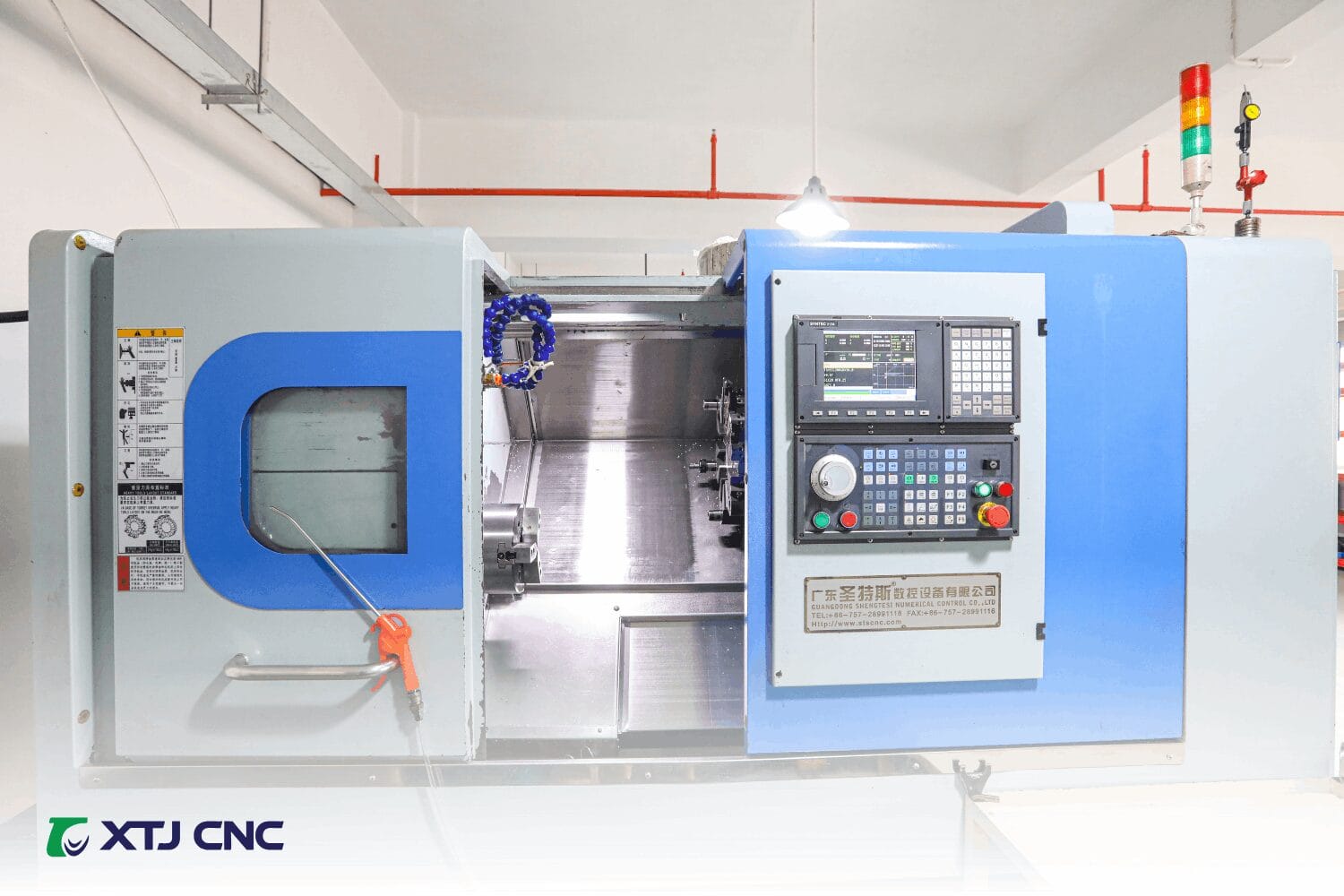
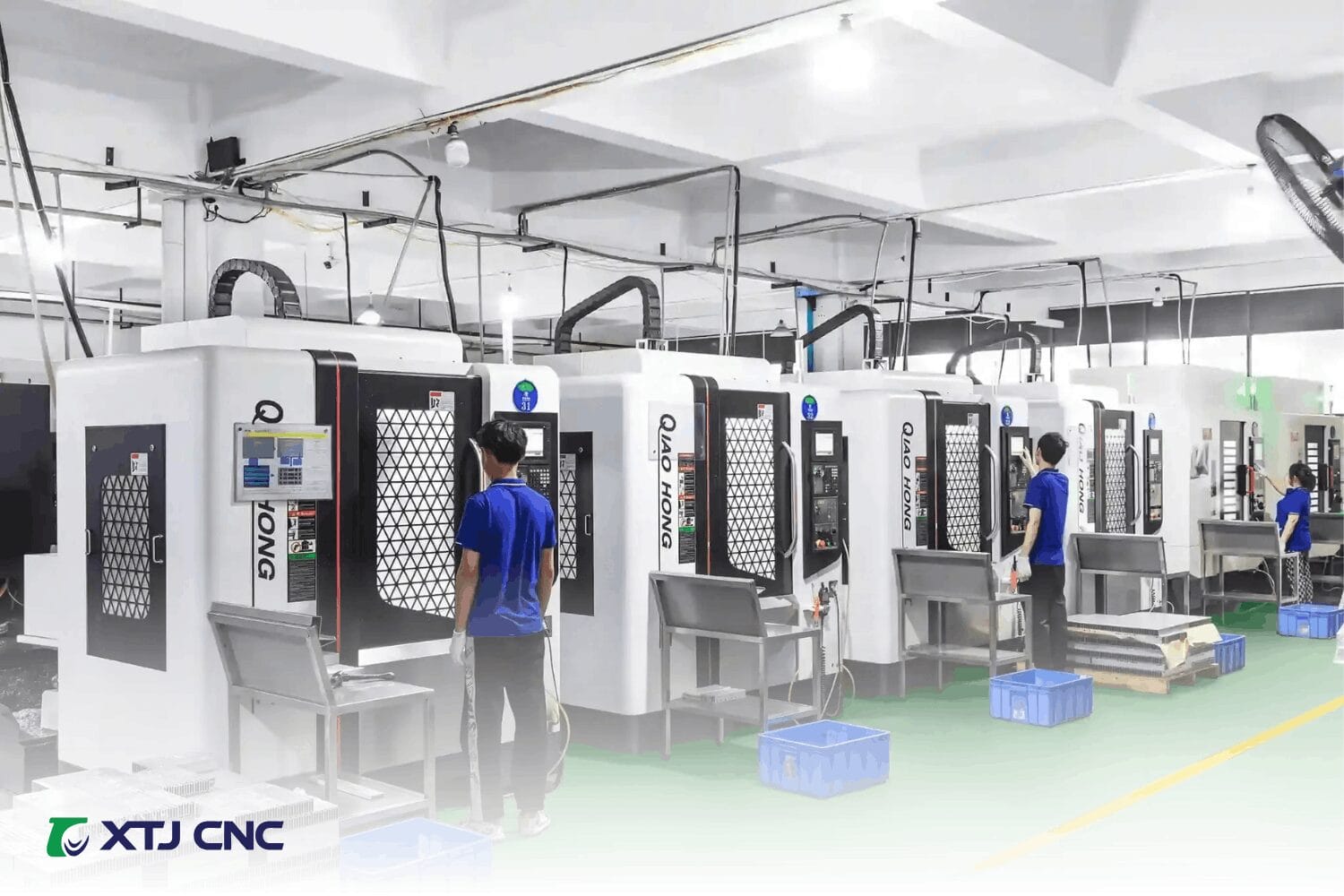
XTJ CNC is a precision custom manufacturing partner operating a 12,000 m² facility in Dongguan with 120+ CNC machines spanning 3-axis to 5-axis milling, turning, and turn-milling. Brass auto parts work covers automotive connectors, valve housings, and sensor housings in C36000, C38500, and lead-free brass grades. Tolerances reach ±0.003 mm – the tightest on this list. For a full overview of brass machining capability, see XTJ CNC’s CNC machining services.
ISO 9001 and IATF 16949 certification with full CMM inspection and material traceability apply to every order. No MOQ: 10 prototype connectors and 5,000 production valve bodies run through the same engineering and inspection workflow. Every new part receives a free DFM review with engineering feedback delivered alongside the quote. Prototype lead times run as few as five days; standard production orders typically ship within 10 to 15 days.
Choose if: You need precision brass auto parts at ±0.003 mm, IATF 16949 documentation for your quality file, or prototype speed without MOQ constraints. The strongest China option for complex geometry, lead-free alloys, and automotive-grade traceability.
2. Yijin Solution
Yijin Solution operates from Shenzhen, Guangdong, as a multi-material CNC shop with documented brass machining capability across C36000, C38500, and aluminum bronze grades. Specialties include CNC-turned brass components, auto-lathe parts, and connectors for electronics and automotive applications. ISO 9001 certified, with established export processes for US and European buyers.
YIJIN’s multi-material capability—brass alongside aluminum and steel on the same equipment—makes them practical for automotive programs that span multiple component materials within a single BOM. For buyers consolidating China suppliers, that breadth reduces vendor count without requiring a separate sourcing relationship for non-brass components.
Choose if: You’re sourcing brass auto parts alongside aluminum or steel components and want to consolidate suppliers. Strong for CNC-turned connectors and auto-lathe parts at mid-volume.
3. Dajin Precision Hardware
Dajin Precision Hardware is based in Dongguan, Guangdong, with 10+ years of CNC turning experience. They specialize in custom CNC turned parts, brass connectors, pins, threaded inserts, and small-diameter precision components. Tolerances fall in the ±0.005 to ±0.01 mm range across HPb63, HPb62, HPb59-1, H59, H62, and H68 brass alloys—one of the widest Chinese brass alloy ranges on this list.
Surface treatment options include nickel plating, zinc plating, passivation, and polishing. Their sweet spot is precision small-diameter turned brass for automotive and electronics—connector pins, threaded inserts, and small-bore fittings where dimensional accuracy on the OD and thread form matters.
Choose if: You need precision small-diameter brass turned parts – connector pins, threaded inserts, small-bore fittings – with the widest brass alloy selection among the China suppliers on this list.
4. HLC Metal Parts
HLC Metal Parts is based in Dongguan, Guangdong, and focuses on custom OEM brass parts with a stated tolerance capability of ±0.01 mm. Specialties include brass turned parts, CNC-milled brass housings, and multi-material precision components. Both small and large batch production are supported across multiple surface finishes.
HLC’s export-focused model targets US and European automotive and industrial buyers. Their multi-material capability – brass alongside other metals – and willingness to handle varied batch sizes make them a practical option for automotive programs that include occasional non-standard geometries or mixed-material assemblies.
Choose if: You need a flexible China CNC supplier for OEM brass housings and turned parts at ±0.01 mm across varied batch sizes, with multi-material capability for mixed automotive programs.
5. MQJM CNC
MQJM CNC operates from Dongguan, Guangdong, specializing in brass turning, multi-axis CNC brass machining, and precision connectors and fittings. Their engineering team averages 20+ years in CNC turning, and full-dimensional verification documentation is maintained on every production batch.
The combination of long operational tenure and emphasis on inspection documentation positions MQJM for buyers whose downstream customers ask for batch-level quality records. For automotive programs where your customer requires documented dimensional verification rather than just a pass/fail certificate, MQJM’s process emphasis is worth evaluating.
Choose if: You need a Dongguan brass CNC shop with a long operational history and batch-level dimensional verification documentation on every production order.
China or India: Which Is Right for Your Project?
The decision comes down to what your specific part requires. The table below maps common procurement requirements to the sourcing region that handles them best. Use it to identify where your project lands before you start sending RFQs.
| Your Requirement | India (Jamnagar) | China (XTJ CNC) |
|---|---|---|
| Simple turned parts (pins, terminals, threaded connectors) | ✓ Strong fit | ✓ Capable, but not the cost advantage |
| Tolerance ±0.02 mm or wider | ✓ Standard production | ✓ Easy |
| Tolerance ±0.01 mm or tighter | △ Requires vetting | ✓ Routine |
| High volume (1,000+ units), cost-driven | ✓ Cost advantage | ✓ Competitive at volume |
| Prototypes (10 to 50 units) | △ MOQ constraints | ✓ No MOQ |
| Complex geometry (multi-axis features) | △ Limited capability | ✓ 5-axis capable |
| RoHS / lead-free brass | △ Requires sourcing verification | ✓ Standard offering |
| IATF 16949 certification | △ Rare | ✓ Available (XTJ CNC, others) |
| DFM review and cost optimization | △ Uncommon | ✓ Free at XTJ CNC |
| Multi-material order (brass + aluminum + steel) | △ Brass specialists only | ✓ Single supplier option |
✓ = strong fit for this requirement △ = possible but requires vetting or has limitations.
Some buyers run both corridors simultaneously: Jamnagar for high-volume simple turned parts, China for precision CNC work and prototype development. That dual-sourcing strategy is legitimate—especially for automotive programs spanning multiple part families with different tolerance and compliance requirements.
India’s Brass Auto Parts Industry: The Jamnagar Advantage
Jamnagar is an ecosystem. Over 5,000 brass manufacturing units operate within the district, employing more than 200,000 workers and generating annual exports exceeding $500 million. The cluster accounts for roughly 70 to 80% of India’s total brass exports, shipping to over 80 countries.
The Jamnagar model runs on two structural advantages. First, recycled material economics: roughly 70% of the brass processed in Jamnagar comes from recycled scrap, keeping raw material costs below global averages. Second, cluster density. When your supplier, their sub-supplier, the raw stock dealer, and the electroplating shop all sit within a 15-kilometer radius, lead times compress, and logistics overhead stays low.
Most Jamnagar units specialize in CNC-turned and auto-turned components: valve bodies, fuel fittings, battery terminals, brake system connectors, and electrical terminal pins. Standard alloys are IS 319 (equivalent to C36000 free-machining brass). Tolerances typically fall in the ±0.02 to ±0.05 mm range for standard production.
Where Jamnagar faces buyer pushback is on the Restriction of Hazardous Substances (RoHS) compliance. Traditional production has relied heavily on C36000 (CuZn39Pb3), which contains roughly 3% lead. For buyers in the EU and North America, where RoHS and low-lead plumbing standards apply, sourcing lead-free alloys like C27450 or C69300 from Jamnagar requires more vetting. The Copper Development Association’s alloy data sheets list lead content by grade and are a useful reference when evaluating supplier material claims.
China’s Brass CNC Machining Capabilities
China approaches brass auto parts differently from Jamnagar. Where India’s strength is high-volume turned components on auto lathes, China’s precision brass machining ecosystem leans on multi-axis CNC capability, tighter tolerances, and a broader alloy range—including lead-free grades that meet RoHS and REACH requirements without special sourcing arrangements.
Shops in Dongguan, Shenzhen, and Ningbo routinely hold ±0.005 to ±0.01 mm on brass CNC parts, running 3-to-5-axis machines from brands including DMG Mori, Mazak, and Haas. For complex geometries like valve housings with cross-drilled ports, threaded inserts with knurled grips, or multi-feature connectors requiring three setups on a standard lathe, China’s multi-axis capability often produces the part in a single setup, which improves dimensional accuracy and per-unit cost simultaneously.
China’s material supply chain supports a wider range of brass alloys. C36000, C38500, C27200, and lead-free options like C69300 are available from domestic mills. On the certification front, established Chinese CNC shops often hold ISO 9001 and International Automotive Task Force (IATF) 16949 alongside RoHS and REACH compliance documentation. For Tier 1 automotive suppliers who need full traceability from raw material to finished part, that certification stack is a meaningful differentiator over most Jamnagar operations.
How XTJ CNC Approaches Brass Auto Parts for Global Buyers
Jamnagar and China serve different brass auto parts needs. Jamnagar wins on volume efficiency for standard turned components. XTJ CNC’s advantages are precision, compliance documentation, and flexibility—what matters when tolerances are tight, a compliance requirement is in play, or the design is still being validated.
XTJ CNC machines brass auto parts across C360, C385, and lead-free alloys on a 120+ machine floor in Dongguan, spanning 3-axis to 5-axis CNC milling, turning, and turn-milling. Tolerances reach ±0.003 mm—tighter than standard production brass turning and verified through CMM inspection on every order. In-house finishing covers nickel plating, chrome plating, electropolishing, and lacquer coating, with full material traceability from bar stock through delivery documentation.
IATF 16949 is the clearest certification differentiator. Most China-based brass shops hold ISO 9001. Far fewer carry IATF 16949, which requires process FMEAs, control plans, and measurement system analysis – demonstrated capability, not just documented processes. At XTJ CNC, that certification covers brass auto parts work as a standard.
The no-MOQ and five-day prototype lead time matter most at the design stage. A connector geometry that still needs validation requires 10 to 25 prototype parts with CMM data – not a 500-unit Jamnagar run that locks the design prematurely. Once the design is confirmed, production batches of 5,000+ parts run through the same process with identical traceability and inspection documentation.
Upload your design files for a free DFM review and quote from XTJ CNC. Pricing and engineering feedback come back within 24 hours.
FAQs on Top Brass Auto Parts & Components Manufacturers
Is Jamnagar brass RoHS compliant?
It depends on the alloy. Traditional Jamnagar production uses IS 319 / C36000, which contains roughly 3% lead and doesn’t meet RoHS thresholds for lead content. Some Jamnagar manufacturers now offer low-lead and lead-free alloys, but buyers should request Material Test Certificates (MTCs) and confirm RoHS compliance documentation before placing orders. The Copper Development Association maintains alloy data sheets listing lead content by grade. If RoHS is a hard requirement, specify C69300 or C27450 explicitly and verify the supplier’s supply chain for these grades.
What tolerances do brass auto parts typically require?
Most brass automotive connectors and fittings work within ±0.02 to ±0.05 mm for non-critical dimensions. Mating surfaces, sealing interfaces, and press-fit bores often need ±0.01 mm or tighter. The tighter the tolerance, the more you benefit from multi-axis CNC capability. Holding ±0.005 mm on a simple auto lathe is difficult; a modern CNC turning center achieves it routinely.
How do China and India’s brass machining costs compare?
For simple turned parts at high volumes (1,000+), Jamnagar is typically cheaper by 15 to 30%. India’s recycled material base and lower overhead keep unit costs low on standard geometries. For complex CNC-machined parts at lower volumes (10 to 500 units), China is often more competitive because multi-axis machining eliminates multiple setups, and prototype-friendly suppliers don’t impose high MOQs. China’s logistics infrastructure often delivers faster door-to-door than Jamnagar for US and European buyers when air freight is factored in.
Can one supplier handle both brass and other metals?
Most Jamnagar shops specialize in brass and copper alloys only. China-based CNC shops typically machine brass alongside aluminum, stainless steel, and titanium on the same equipment. If your automotive program includes brass connectors, aluminum housings, and stainless steel shafts, a multi-material Chinese CNC supplier consolidates your supply chain into fewer vendors without a process quality compromise.
What should a buyer ask before placing a brass auto parts order with a new supplier?
Five questions worth asking upfront: Which brass alloys do you stock or source regularly? Can you provide material test certificates for every batch? What’s your tolerance capability, and can you show CMM reports from recent production? Do you hold ISO 9001 or IATF 16949 certification? What’s your lead time for a first-article run of 25 units? How quickly those answers come—and how specific they are—tells you more about process maturity than any capability claim on a website.
Back to Top: Top Brass Auto Parts & Components Manufacturers: China vs India (2026)