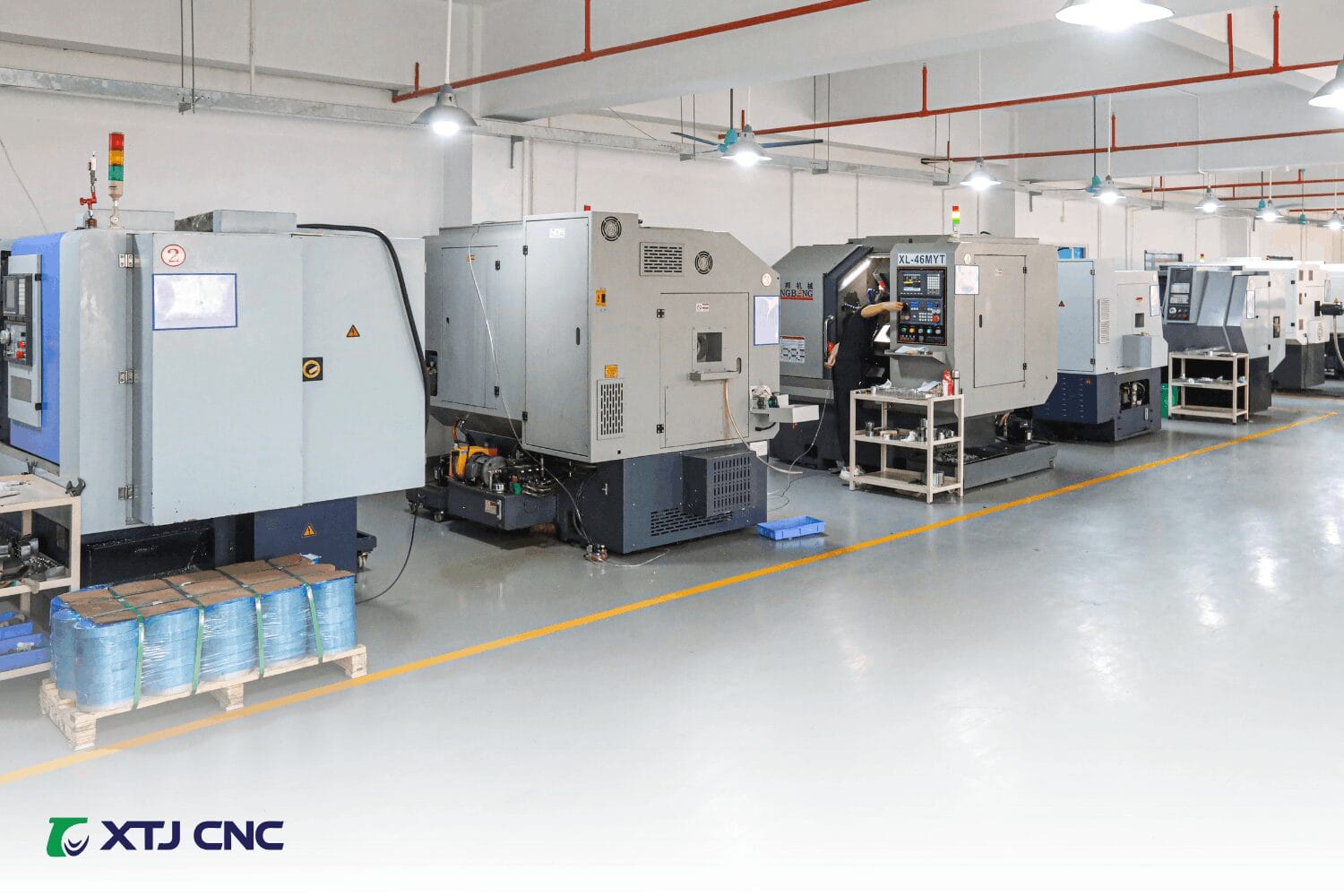
When sourcing teams ask why CNC machining costs 30 to 50% less in China than in the US or Europe, the most common answer is labor cost. That explanation covers roughly 20% of the real picture. The actual cost structure is a layered system of structural advantages: machine density, vertically integrated supply chains, low overhead, government infrastructure investment, and a domestic equipment industry that has driven down capital costs. Each factor shaves a few percentage points off the final per-part price. Combined, they create a pricing differential that no single variable explains.
This guide breaks down each cost driver with real numbers, addresses the quality question directly, and explains when China-based CNC machining services make financial sense for your project—and when they don’t.
How Big is the Cost Gap, Really?
Before getting into the mechanics, here’s how typical CNC machining costs compare between China and Western markets. These figures reflect pricing from on-demand custom manufacturing service providers.
| Cost Category | China (USD) | US / Europe (USD) | Typical Savings |
|---|---|---|---|
| 3-axis CNC milling rate | $20 to $60/hr | $50 to $100/hr | 30 to 50% |
| 5-axis CNC milling rate | $60 to $140/hr | $100 to $200/hr | 25 to 40% |
| CNC operator monthly wage | $1,100 to $2,100 | $3,500 to $5,500+ | 50 to 70% |
| Industrial electricity | $0.08 to $0.12/kWh | $0.10 to $0.20/kWh | 15 to 40% |
| Simple aluminum part (batch of 100) | $5 to $15/unit | $15 to $40/unit | 40 to 65% |
| Complex 5-axis steel part (prototype) | $100 to $250 | $200 to $500+ | 30 to 50% |
*Sources: ERI SalaryExpert (2026), Grand View Research CNC Machine Market Report (2025), China Briefing industrial power data (2025), aggregated service provider quotes.*
It’s Not Just Cheap Labor—But Labor Still Matters
Wages are the most visible cost advantage. According to ERI SalaryExpert’s 2026 data, the average CNC operator in China earns roughly CNY 117,000 per year ($16,400). A CNC machinist with programming capability earns closer to CNY 147,000 ($20,500). By comparison, the US Bureau of Labor Statistics reports a median CNC tool operator salary of $52,900, with programmers at a median of $69,880.
That’s a 2.5-to-3.5x wage differential depending on the role, and it shows up directly in hourly shop rates. But the story gets more interesting when you look at what that labor actually delivers.
China’s manufacturing workforce is specialized and deep. The Pearl River Delta region alone employs hundreds of thousands of machinists, many with 10 to 20 years of production floor experience. These aren’t entry-level operators. They’re experienced machinists running multi-axis setups on DMG Mori and Mazak machines, interpreting Geometric Dimensioning and Tolerancing (GD&T), and catching tolerance drift before the coordinate measuring machine (CMM) confirms it.
The lower wage doesn’t reflect lower skill. It reflects a different cost-of-living structure, a massive labor supply in manufacturing regions, and decades of industrial concentration that made precision machining a mainstream career path rather than a niche trade.
How does Machine Density Drive Cost Down?
Walk through a mid-size CNC shop in the US or Germany, and you’ll typically count 10 to 30 machines. Walk through a comparable facility in Dongguan or Ningbo, and you’ll count 80 to 200 machines on a single floor. For example, XTJ CNC’s 12,000 m² Dongguan facility runs 120+ CNC machines across 3-axis, 4-axis, and 5-axis configurations—and that scale is not unusual for the region.
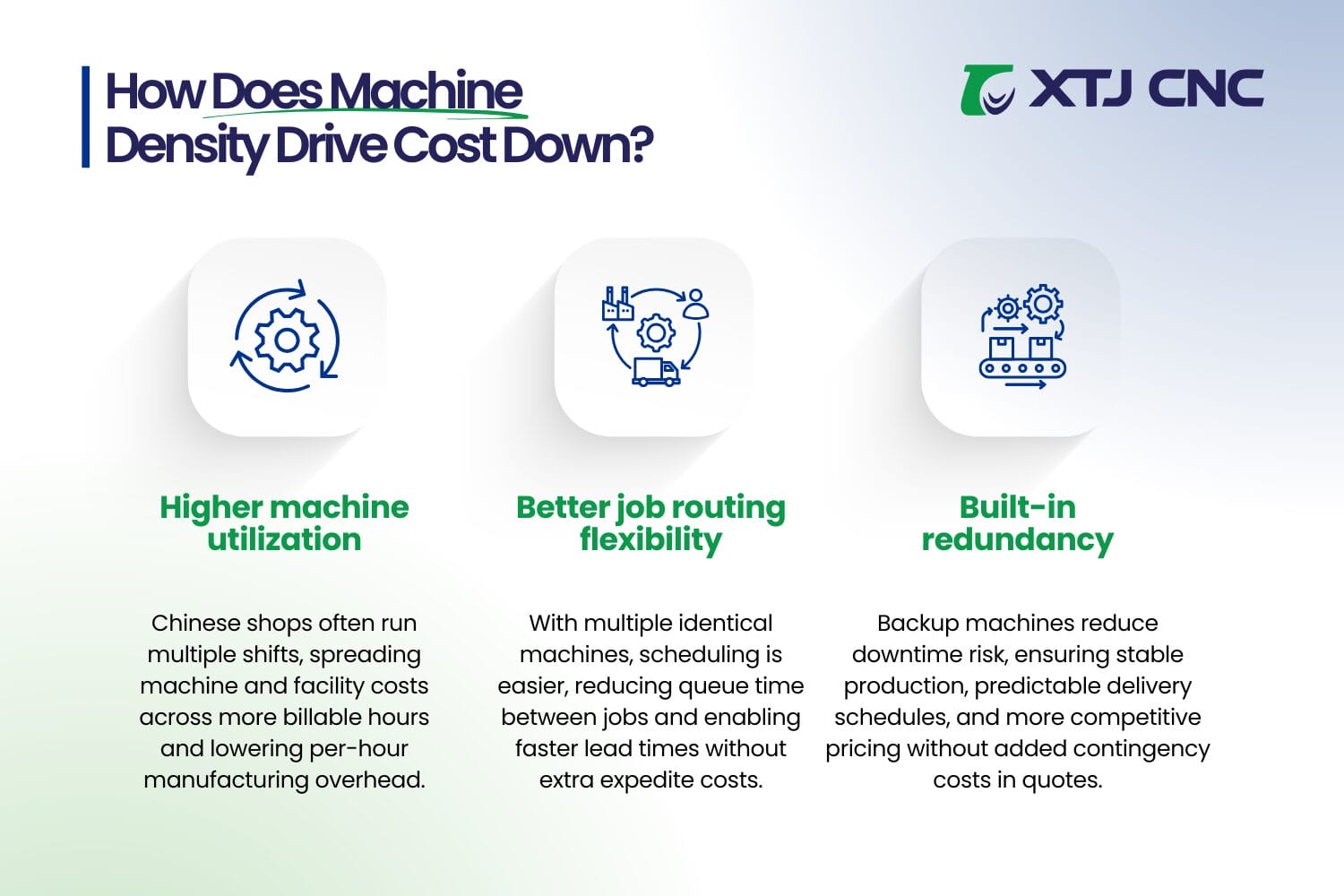
This density drives cost down in three specific ways.
1. Higher machine utilization
With more machines and more operators, Chinese shops routinely run two or three shifts. A 5-axis mill that sits idle 40% of the time in a one-shift Western shop runs 80 to 90% of the day in a two-shift Chinese operation. The machine’s depreciation, lease cost, and floor space cost spread across nearly twice as many billable hours, so the per-hour overhead drops accordingly.
2. Better job routing flexibility
When a shop has 15 identical 3-axis vertical machining centers and another 10 turning centers, scheduling becomes straightforward. There’s always a machine available, which means less queue time between jobs and shorter lead times without expedite charges.
3. Built-in redundancy
If a machine goes down for maintenance, another one is ready. That operational resilience translates into more predictable delivery schedules—and more competitive pricing, because the shop isn’t building downtime risk premiums into every quote.
What Role Does Supply Chain Depth Play?
This may be the most underappreciated cost driver. China doesn’t just manufacture parts—it manufactures everything that goes into manufacturing parts. According to China Briefing, China accounts for nearly 30% of global manufacturing output and operates the most comprehensive industrial network in the world, spanning every major UN manufacturing category.
For a CNC machining shop, the supply chain depth has three direct cost implications.
- Lower material costs: Aluminum billet, steel bar stock, and stainless rod are sourced domestically at prices that reflect local production economics, not import markups. China is the world’s largest aluminum producer. A shop in Dongguan buying 6061-T6 aluminum bar stock pays less per kilogram than a shop in Michigan buying from a domestic distributor.
- Faster access to consumables: Carbide inserts, collets, coolant, and workholding components are available locally—often from factories within the same industrial park. That reduces lead time on tooling replenishment and cuts procurement overhead significantly.
- Integrated post-processing: Anodizing, heat treatment, electropolishing, powder coating, and bead blasting are co-located with machining facilities across Guangdong’s industrial clusters. A Western shop sourcing the same secondary operations might be shipping parts across state lines, adding days and cost between operations.
How do Overhead and Facility Costs Compare?
Industrial electricity in China’s manufacturing regions averages $0.08 to $0.12 per kWh for large-scale industrial users, according to AmCham China and China Briefing. That’s 30 to 50% below what a comparable shop pays in the US Midwest ($0.10 to $0.14/kWh) and well below Western European rates ($0.15 to $0.25/kWh). A single 5-axis machining center draws 15 to 30 kW under load. Multiply that across a full production floor running two shifts, and the annual savings on power alone reach tens of thousands of dollars.
Factory space and construction costs follow the same pattern. Industrial land in manufacturing zones like Dongguan or Ningbo costs a fraction of equivalent space in the US or Germany. Many Chinese manufacturers operate in purpose-built industrial parks with shared logistics infrastructure, further reducing per-square-meter operating costs.
Insurance, compliance, and administrative overhead sit lower, too. Reputable Chinese manufacturers absolutely invest in quality systems—ISO 9001, IATF 16949, and CMM inspection are standard at established shops—but the baseline cost of regulatory compliance and workers’ compensation is structurally lower than in Western markets.
Why do Economies of Scale Work Differently in China?
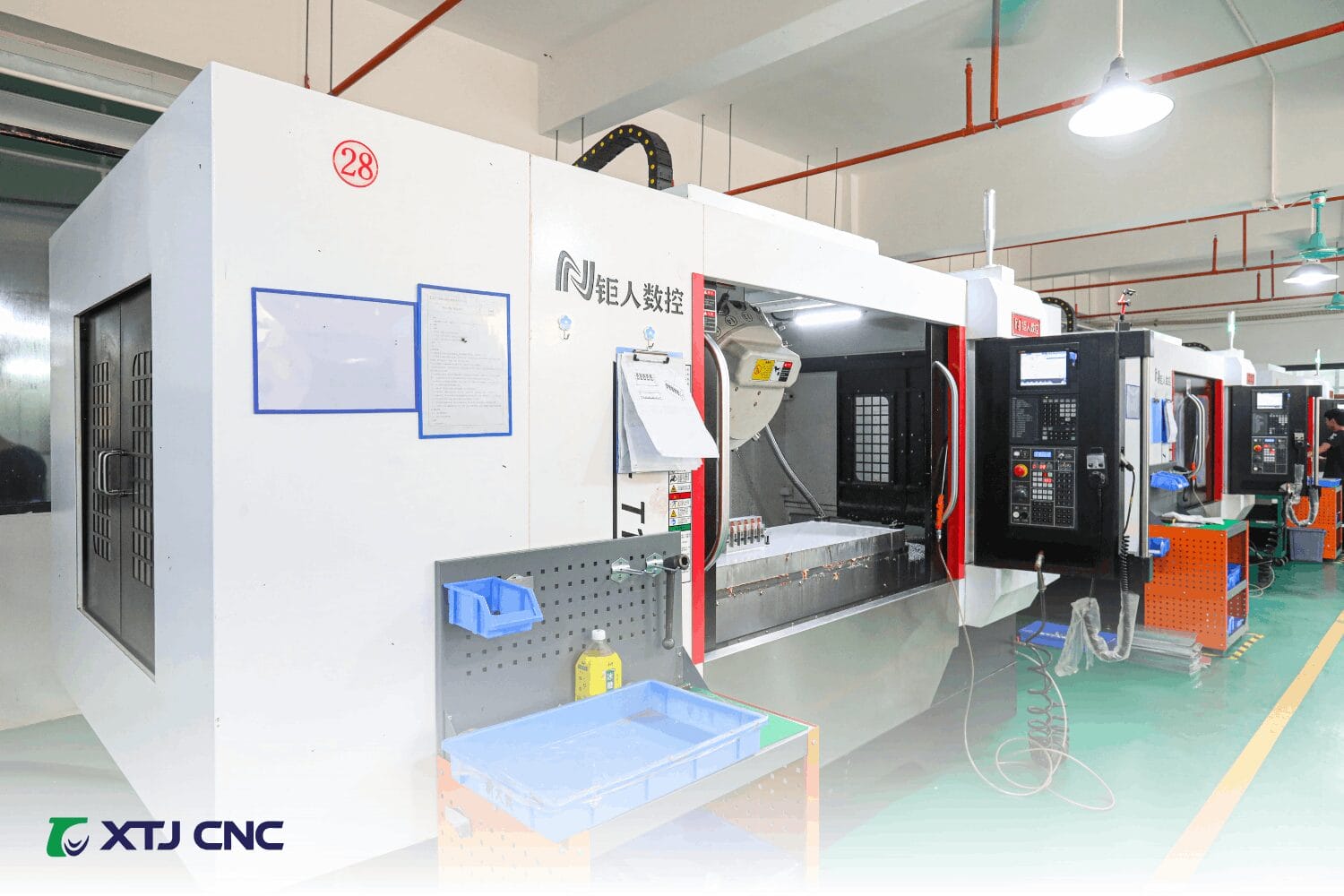
China has maintained its position as the world’s largest manufacturer for 15 consecutive years, with manufacturing value-added output reaching $4.66 trillion in 2024 – roughly 28% of the global total, according to CSIS ChinaPower. That scale filters down to individual shops.
When a facility runs hundreds of similar jobs per month, process efficiencies develop that smaller-volume shops can’t replicate. Toolpath libraries get refined. Setup procedures get standardized. Operators build pattern recognition that lets them catch issues earlier. The result is shorter cycle times, lower scrap rates, and better first-pass yield – all of which reduce cost per part without requiring a pricing concession.
Batch economics amplify the effect. A shop quoting 5,000 stainless steel fittings amortizes programming, fixturing, and first-article inspection costs across a volume that makes per-unit overhead almost negligible. The same job in a smaller Western shop carries three to five times the setup cost burden simply because that volume doesn’t arrive regularly enough to optimize for it.
How do Government Policies Affect Manufacturing Costs?
China’s manufacturing cost advantage isn’t purely organic. Deliberate policy has shaped the landscape over decades.
Infrastructure investment is the most tangible factor. China has built industrial zones, logistics networks, port facilities, and transportation corridors specifically designed to support manufacturing output. That infrastructure reduces logistics costs for every manufacturer operating within it—and those savings pass through to per-part pricing.
Industrial policy incentives also play a role. Tax benefits, subsidized land for manufacturing facilities, and R&D grants for automation and advanced equipment have helped Chinese manufacturers invest in newer, faster machines at a lower effective cost of capital. The “Made in China 2025” initiative specifically targeted advanced manufacturing, driving investment into 5-axis machining centers, automation, and quality systems.
Energy policy deserves its own mention. China’s rapid expansion of renewable energy capacity—wind and solar capacity surpassed coal for the first time in Q1 2025, according to China Briefing—is putting downward pressure on industrial electricity prices in several manufacturing regions. In Guangdong, spot electricity prices have dropped below $0.04/kWh during certain periods, a direct benefit for power-intensive CNC operations.
Does China’s Domestic CNC Machine Industry Help?
There’s a cost driver that most competitor articles miss entirely: China’s growing domestic CNC machine tool industry.
Historically, Chinese manufacturers relied heavily on imported machines from DMG Mori, Mazak, Haas, and Fanuc. These are still widely used, and for tight-tolerance work, they remain the benchmark. Over the past decade, however, Chinese machine builders have closed much of the gap for mid-range applications. Domestic 3-axis vertical machining centers that deliver ±0.01 mm repeatability now cost 40 to 60% less than imported equivalents.
When the capital cost of a machine is lower, the depreciation charge per hour is lower, and the required billing rate drops accordingly. For standard-tolerance work (±0.05 mm or looser), a well-maintained domestic machine delivers equivalent results at a fraction of the acquisition cost. Premium imported machines – simultaneous 5-axis centers and Swiss-type lathes with sub-spindles – still carry significant price tags, but even here the total cost of ownership is lower in China because of cheaper installation, lower facility costs, and more competitive maintenance labor rates.
Does Cheap Mean Low Quality?
This is the question that makes or breaks the sourcing decision. The honest answer: it depends entirely on the supplier you choose.
Low prices in China are a structural advantage—a result of the factors outlined above. They don’t inherently mean corners are being cut. Certified manufacturers like XTJ CNC hold ISO 9001 and IATF 16949, run CMM inspection on every production batch, and use the same cutting tool brands and machine equipment as shops in the US or Germany.
The risk isn’t that Chinese manufacturing is inherently low quality. The risk is that the range of quality is wider than in more regulated Western markets. There are shops in Dongguan holding ±0.003 mm on hardened steel parts for automotive OEMs, and there are shops across town running loose-tolerance commodity work with minimal inspection. Both exist. The following criteria help you identify which type of supplier you’re dealing with.
- Certifications with audit history. ISO 9001 is the baseline. For automotive work, IATF 16949. Ask for the certificate, the certifying body, and the last audit date. Verify independently.
- Equipment transparency. A credible shop names the machines they run—brand, model, and axis count—and doesn’t hesitate to share production floor photos or video.
- DFM review capability. If a supplier can’t review your part design and suggest manufacturing improvements, they’re likely not operating at the engineering depth you need.
- First-article inspection reports. Any serious manufacturer produces a first-article inspection (FAI) report on new parts with actual measured values against nominal dimensions. If they don’t mention it, ask.
- Material traceability. Reputable shops provide material certifications (mill certs) and trace raw material back to the supplier. This is standard practice, not a premium service.
When does China CNC Machining Make Sense?
The decision isn’t binary. China makes sense for a wide range of commercial manufacturing work. Domestic production makes sense in specific situations that have nothing to do with quality or price. The table below maps both sides of that decision.
| China CNC machining makes sense when… | Consider keeping production domestic when… |
|---|---|
| Batch sizes are medium to large (50 to 5,000+ units), where per-unit setup and shipping costs amortize across volume. | You need single-digit unit quantities with same-week turnaround and no tolerance for shipping delays. |
| Tolerances fall in the standard-to-precision range (±0.01 to ±0.05 mm), achievable across a wide range of Chinese CNC shops. | In-person collaboration between design and manufacturing is essential to your development process. |
| Lead time accommodates two to four weeks of ocean freight, or air freight cost is manageable on your part, size, and weight. | Intellectual property risk is a primary concern, and your product design cannot be exposed to overseas supply chains. |
| RoHS, REACH, ISO 9001, or IATF 16949 documentation is required—certified Chinese shops meet these standards as standard. | Your project requires tight supply chain control that only physical proximity to your manufacturing partner provides. |
| You want free DFM review and engineering feedback included in the quoting process, not billed as a separate service. | Your volumes are too low for the landed-cost calculation to favor offshore production, even with the per-part saving. |
For many buyers, the most practical approach is a hybrid: prototype domestically for speed and iteration, then move to a China-based manufacturing partner for production volumes where the cost differential compounds over time.
How do You Find a Reliable, Low-Cost CNC Supplier in China?
Finding the right supplier matters more than finding the cheapest one. Start with a DFM review—upload your CAD files and request Design for Manufacturability feedback before committing. A supplier that provides engineering observations, flagging features that drive cost, and suggesting alternatives is demonstrating capability, not just capacity. XTJ CNC’s free DFM review is a practical starting point for any new project.
- Request material certifications upfront. Ask to see mill certs for the material grades you need. If a supplier can’t provide them or doesn’t understand the request, move on.
- Ask about inspection capability. Does the shop have CMM equipment? What’s their standard inspection protocol? Do they provide dimensional reports with shipments? These questions separate process-disciplined shops from cutting services.
- Check certifications and references. ISO 9001 at minimum. IATF 16949 for automotive. Ask for client references in your industry and follow up on them.
- Evaluate communication quality. The ability to discuss tolerances, GD&T, and material specifications in clear technical English is a strong indicator of engineering depth. Vague answers to specific technical questions are a signal worth taking seriously.
How XTJ CNC Delivers Competitive Pricing Without Compromising Precision
XTJ CNC is a precision manufacturing partner with 20+ years of experience in CNC machining and rapid prototyping, operating a 12,000 m² facility in Dongguan with 120+ machines spanning 3-axis through 5-axis CNC milling, turning, and turn-milling. We serve OEMs across automotive, medical, electronics, and industrial equipment—delivering the structural cost advantages described in this article alongside the quality systems and engineering support that serious buyers require. For a full overview of what’s available, see XTJ CNC’s CNC machining services.
Our cost position is straightforward: China’s structural advantages—machine density, supply chain depth, lower overhead—are real, and they flow through to our pricing. What we add on top of that is an engineering discipline. Tolerances down to ±0.003 mm across milling and turning. ISO 9001 and IATF 16949 certification with CMM inspection and full material traceability on every order. No MOQ. Prototypes in as few as five days. Every new part gets a free DFM review before production begins.
If you’re evaluating China-based CNC machining for your next project, upload your design files for a free quote and DFM review. We respond with pricing and engineering feedback within 24 hours.
FAQs on Why is CNC Machining So Cheap in China?
How much cheaper is CNC machining in China compared to the USA?
For most applications, China-based CNC machining runs 30 to 50% less per part than equivalent work from a US shop. Simple aluminum parts at production volumes see the widest gap – up to 60% in some cases. Tight-tolerance 5-axis work in exotic materials narrows it to 20 to 35%. The most reliable way to benchmark your specific project is to request parallel quotes from a qualified Chinese manufacturer and a domestic shop using identical drawings and specifications.
How do I verify that a low-cost Chinese CNC supplier isn’t cutting corners?
Request three things before placing a production order: a current ISO 9001 or IATF 16949 certificate with the certifying body’s name and last audit date, a first-article inspection (FAI) report on your specific part with actual measured values, and material certifications (mill certs) for the alloy grades you need. Any reputable manufacturer provides all three without hesitation. If a supplier can’t produce these documents or doesn’t understand the request, treat that as a disqualifying signal.
Are shipping costs and tariffs going to wipe out the savings?
Ocean freight from China to the US typically adds $2 to $8 per kilogram for machined parts, with transit times of two to four weeks. For parts with a unit value of $20 to $30, freight cost is proportionally small—often 5 to 15% of the part price. Import duties vary by material and HS code, typically ranging from zero to 25%. Even with shipping and duties factored in, the total landed cost for most CNC-machined parts remains 20 to 40% below domestic pricing. Air freight is available for urgent orders, but it erodes savings significantly on heavy or bulky parts.
What’s the minimum order quantity from Chinese CNC manufacturers?
It varies by supplier. Some shops focus on production volumes and set MOQs at 100 to 500 pieces. Others, including XTJ CNC, have no MOQ and will machine a single prototype. If you’re prototyping or running short batches, confirm the MOQ policy before requesting a quote—it affects whether the pricing you’re comparing is actually available at your volume.
Can Chinese CNC shops handle tight tolerances and complex 5-axis work?
The leading shops do it routinely. Facilities equipped with DMG Mori, Mazak, or Haas 5-axis machining centers and supported by CMM inspection hold tolerances down to ±0.003 mm on production parts. The capability exists. The question isn’t whether China can do precision machining – it’s whether the specific shop you’re quoting has the equipment, experience, and quality systems to deliver it. That’s exactly what the DFM review and first-article process are designed to verify.
Back to Top: Why is CNC Machining So Cheap in China?